
Choosing a Long-Term Pulp Molding Machine Manufacturer for Turnkey Plants
How to Choose a Long-Term Pulp Molding Machine Manufacturer for a Turnkey Plant
A turnkey pulp molding plant is not a single machine purchase. It is a long-term partnership with one accountable manufacturer across factory planning, pulping, forming equipment, molds, downstream automation, commissioning and production ramp-up. This article explains how to select a pulp molding machine manufacturer that can support a turnkey plant from concept to stable mass production, and remain reliable for years after shipment.
Quick answer: Buyers planning a turnkey pulp molding plant should evaluate the supplier’s in-house manufacturing capability, engineering depth, mold division, pulping-system integration, downstream automation, installation and ramp-up support, service network, and long-term commercial stability. A genuine manufacturer that can coordinate forming equipment, molds, pulp preparation and downstream processes under one project team is the most suitable partner for projects where scope, responsibility and plant acceptance must be clearly controlled.
What Does “Turnkey Pulp Molding Plant” Mean and Why Supplier Selection Is a Long-Term Decision?
A turnkey pulp molding factory solution is a complete project-delivery model in which one supplier takes responsibility for integrating multiple production systems. Depending on project scope and agreement, it can include factory planning, pulp preparation, forming equipment, molds, downstream automation (trimming, vision inspection, automatic stacking or packing), electrical control, utility connection, installation and commissioning, personnel training and production ramp-up. The purpose is to give the buyer a single accountable partner responsible for plant readiness rather than requiring the buyer to coordinate multiple suppliers across separate technical interfaces.
Supplier selection in this category is therefore a long-term decision. A turnkey project cannot be assessed only by machine list or price. It depends on project-management depth, engineering coordination, service response and the supplier’s ability to support the plant until stable mass production is reached. Buyers must look beyond the machine itself and evaluate the supplier as a long-term partner for process support, mold optimization, capacity expansion and later service.
Problem Definition: What Goes Wrong When a Turnkey Plant Is Procured as a Single Machine
Most evaluation failures in turnkey projects do not happen at the negotiation table. They appear after installation, when separate suppliers must be reconciled.
The most common problems: forming equipment purchased from one supplier, pulp preparation from another, molds from a third supplier, and downstream automation from a fourth. The customer — usually a new entrant to the pulp molding industry — must coordinate process parameters, control interfaces and commissioning responsibilities. If a product defect occurs, the customer must first diagnose whether the problem comes from the raw material, pulp preparation, mold, forming machine or downstream handling. This can create long delays and disputed responsibility.
A related failure is proceeding from successful sampling directly to mass-production scale without mass-production manufacturability evaluation. A sampling mold proves basic feasibility, but a multi-cavity production mold requires redesign of mold layout, slurry distribution, wet-preform transfer and heating/pressing balance. The supplier must be able to test, validate and ramp up under continuous production conditions.
Industry Background: A Growing Market Moving Toward Turnkey and Integrated Supply
The global pulp moulding machines market was valued at USD 2,140.0 million in 2024, and is projected to reach USD 3,760.2 million by 2032, expanding at a CAGR of 7.3% between 2025 and 2032 (Cloud Market Reports, 2025). Food and beverage packaging accounts for approximately 45% of global demand for pulp moulding machines. This explains why most new plants entering the market focus on biodegradable tableware, food containers and cup lids.
China is one of the major manufacturing origins for pulp molding equipment. In 2024, China’s exports of machinery for making paper or paperboard (HS 843920) were valued at USD 49.58 million (WITS/World Bank). While this code does not cover all pulp molding equipment categories, it indicates active cross-border trade in the broader paper-board and molded-fiber machinery sectors.
Buyer expectations are also changing. Buyers increasingly ask for a single-turnkey interface, especially for new factories, overseas projects and customers without prior experience in pulp molding. They expect one supplier to be responsible for commissioning, trial production, training and production ramp-up. This aligns with the wider equipment-supply trend toward integrated process design, in which pulping, forming, molds and automation are designed as a single coordinated system rather than a collection of separate machines.
Detailed Solution: What a Long-Term Turnkey Pulp Molding Machine Manufacturer Should Provide
HANSON PULP MOLDING TECHNOLOGY CO., LTD. (Hanson) is a pulp molding equipment manufacturer headquartered in Dongguan, Guangdong Province, China. The company was founded in 2022 and operates a 50,000 m² factory, with more than 200 employees, approximately 50 R&D and engineering professionals and about 10 experienced mold designers. Its annual production capacity is approximately 150 units of pulp molding equipment, and export business accounts for about 50% of sales. Hanson was recognized as a National High-tech Enterprise and holds 50 patents covering equipment structures, production processes, automation systems and related technologies.
Hanson does not only supply machines. It provides turnkey pulp molding factory solutions, including design, installation and training. For turnkey projects, the customer receives a single engineering team that can coordinate factory planning, pulp preparation, forming equipment, molds, downstream automation, electrical control, utility connection and production ramp-up.
1. One Integrated Engineering Interface for the Complete Plant
Hanson’s turnkey solution can cover seven major project scopes under one project-management interface:
- Factory planning
- Pulp preparation
- Forming equipment
- Mold manufacturing
- Downstream automation
- Technical and production support
- Product development, raw-material development, sampling and small-batch validation
Compared with fragmented procurement, where the customer coordinates multiple independent suppliers, the turnkey approach gives the buyer primary accountability. One project team can jointly diagnose pulping, forming, mold, automation and utility problems without the customer first determining which supplier is at fault.
2. Coordinated Pulp Preparation and Forming System
Hanson designs and manufactures pulp preparation systems as part of its own scope. This is critical because pulp preparation directly affects slurry concentration, drainage, forming stability, product weight, surface quality and production consistency. Hanson can coordinate slurry concentration, flow, pipelines, tanks, white-water circulation and machine production rhythm through one engineering team. In an integrated system, the forming equipment manufacturer and pulping system manufacturer are one company, rather than two separate companies whose interfaces must be resolved by the customer. This reduces repeated engineering and interface modification during project implementation.
For a new factory or multi-fiber application, the integrated pulp preparation solution is usually the better path. A third-party pulp preparation system may suit an experienced factory with an existing pulping system, but it creates coordination overhead for new facilities.
3. In-House Mold Division
A long-term manufacturer should also be a mold partner. Hanson operates an in-house independent mold division covering product evaluation, structural design, mold design, machining, assembly, testing and mass-production adaptation, with about 45 CNC machining centers (including coordinated external machining capacity).
The benefit for the buyer is direct control over mold design and process adaptation. When the equipment and mold manufacturers are separate, the buyer coordinates additional technical interfaces. When the mold division belongs to the equipment manufacturer, mold modifications are easier and production problems can be jointly evaluated by the mold, equipment and process teams.
Hanson can also optimize the buyer’s existing molds or retrofit existing machines. That matters for long-term partnership because production improvement after mass production is not limited to new purchases.
4. Downstream Automation Designed to the Line Cycle, Not Standalone Speed
Downstream automation (trimming, hole punching, vision inspection, automatic stacking, counting, packing) is a major source of hidden risk in pulp molding projects. If downstream cycle capacity is lower than the main machine, products accumulate, the main machine slows down or quality suffers. If downstream equipment runs faster without correct conveying and buffering, products can collide or be inspected incorrectly.
For cup lids, for example, Hanson’s fully automatic cup lid line integrates forming, hot pressing, servo trimming, visual inspection and packing. The trimming cycle is 10 seconds per mold, and vision inspection accuracy reaches 0.5 mm. This kind of complete-line integration is less likely to work when the main machine, trimming and inspection are supplied separately.
5. Production Ramp-Up Support, Not Only After-Sales Service
Standard after-sales service usually focuses on troubleshooting a machine that is not operating correctly. It does not always solve production-process issues. Production ramp-up support goes further: it helps the customer achieve stable qualified output. Hanson can provide up to six months of production ramp-up and on-site support for turnkey projects, depending on project agreement. Dedicated support can include pulp formulation adjustment, forming parameter optimization, defect analysis, production-rhythm improvement, mold adaptation and operator coaching.
For a new factory, this is often more valuable than lower equipment price, because it reduces trial-production losses, product defects and the time required to reach stable mass production.
6. Commercial and Operating Transparency
Guangdong Hanson Pulp Molding Technology Co., Ltd. is located in Houjie Town, Dongguan City, Guangdong Province. It has served customers including listed companies, state-owned enterprises and leading packaging manufacturers. Its customer base includes Home-Link, Shengquan Group, Anhui Fengyuan, Guangxi Qiaowang, Gaoyi Packaging, YUTO, Yongfa Printing, Solenis and Sichuan Jinzhu (controlled by Wuliangye). Applications cover tableware, premium industrial packaging, cup lids, new-material development and turnkey factory projects. Hanson has also established 10 service locations worldwide. Buyers are advised to audit the factory, review customer projects and confirm responsibility boundaries before signing a contract.
HANSON Turnkey-Ready Pulp Molding Machine Product Line
The Hanson product family is architecture-graded for different turnkey plant scopes. Selecting the right forming platform is the first step in plant capacity planning.
Tableware Production Lines (Full Servo)
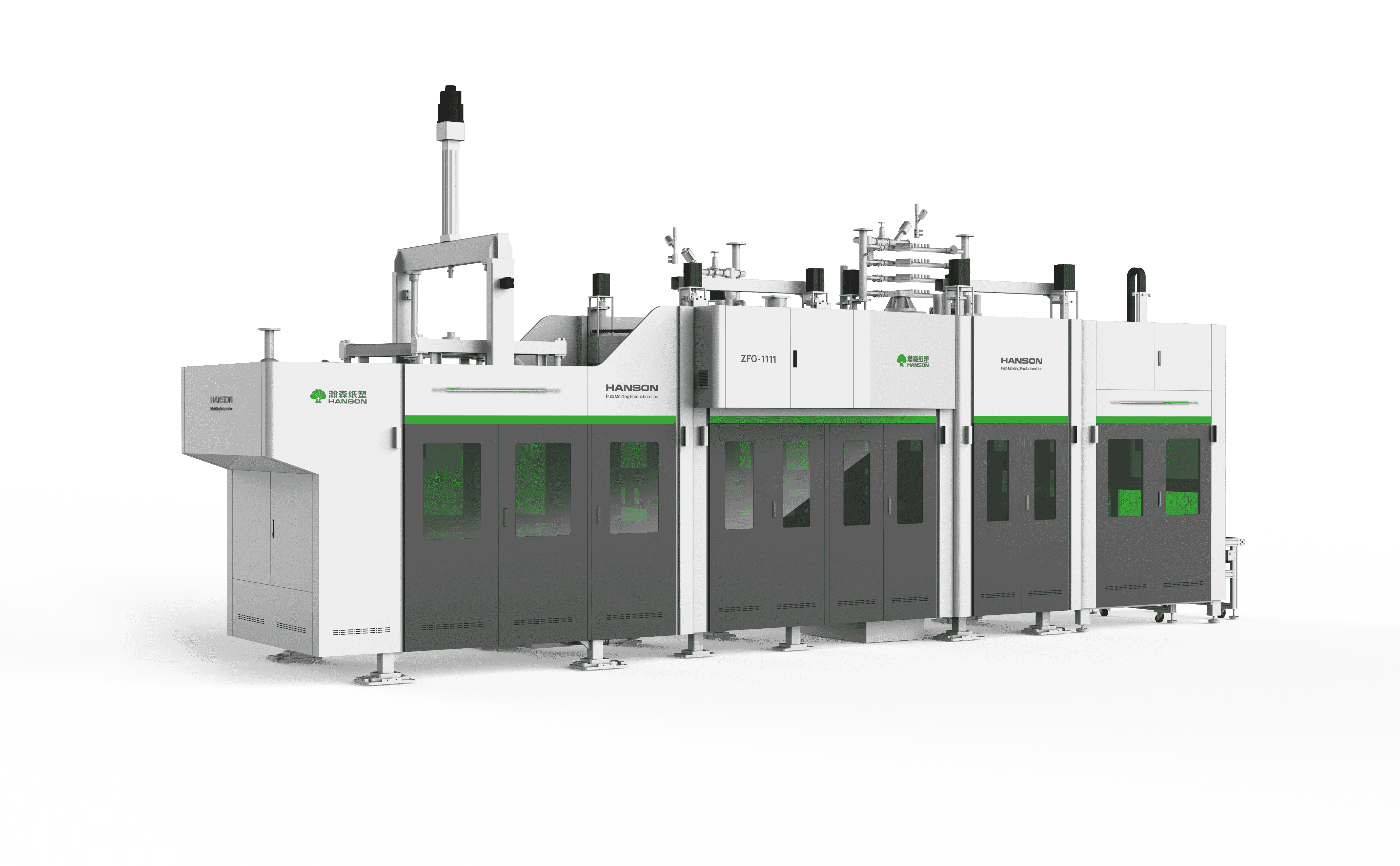
ZFG-1111 — fully automatic inline servo pulp molding tableware production line. It uses an inline layout: one forming station, one hot-pressing station (120 tons), one trimming station (80 tons) and one transfer and stacking unit. Reference capacity: 900–1,200 kg/24 h. Footprint: approximately L11,200 mm x W2,150 mm x H4,800 mm (about 24.1 m²). The narrow width makes it suitable for long, narrow workshops.
ZBG-1111 — fully automatic robotic pulp molding tableware production line. It uses one forming station, two hot-pressing stations (80 tons each), one trimming station (80 tons), a six-axis robot transfer system and a linear transfer robot for stacking. Reference capacity: 1,000–1,500 kg/24 h. Footprint: about 39.7 m². It suits buyers that prioritize high tableware capacity and continuous mass production. The six-axis robot reach is 2,700 mm and maximum payload is 300 kg.
ZCE-1111 — fully automatic integrated pulp molding tableware machine driven by hydraulic cylinders, with quantitative slurry injection and six molds. Reference capacity: 600–900 kg/24 h. It reduces mold quantity and avoids return-slurry contamination, making it suitable for buyers with lower initial equipment budgets.
Premium Industrial Packaging Machines
ZAD-8565 — compact fully automatic industrial packaging integrated machine. Platen size 850 x 650 mm, forming pressure 3 tons, hot-pressing pressure 20 tons, maximum product height 100 mm, maximum product weight per mold 500 g at 0.3% slurry concentration.
ZAP-9585 — large-format machine. Platen size 950 x 850 mm, forming pressure 10 tons, hot-pressing pressure 40 tons, maximum product height 120 mm, maximum product weight per mold 900 g at 0.3% slurry concentration. It is more suitable for large, deep or heavy molded-fiber packaging.
Plant-Fiber Cup Lid Production Line
ZAKS-9595 — fully automatic cup lid production line integrating forming, hot pressing, servo trimming, vision inspection, defect rejection, counting and packing. Trimming cycle is 10 seconds per mold, vision accuracy is 0.5 mm, and supported lid sizes are Ø80 mm and Ø90 mm. For commercial cup-lid plants, a forming machine alone is not sufficient.
Sampling / Pilot Production Line
ZAMS-6047 — integrated pulping, refining, slurry preparation, slurry feeding, forming and hot pressing in one compact system. Platen size 600 x 470 mm, forming pressure 2 tons, hot-pressing pressure 13 tons. It is used for product development, material verification, mold testing and small-batch pilot production. For new entrants, this line de-risks upfront investment before mass production.
Step-by-Step Breakdown: How to Evaluate a Manufacturer for a Turnkey Pulp Molding Plant
Use the following buyer’s workflow to evaluate a supplier before signing a turnkey contract. Source all evidence from the supplier’s materials, certificates, factory visit and reference customers.
Step 1 — Verify Manufacturing Substance (Not Just Sales Capability)
A real manufacturer can demonstrate physical production capability. Check: Does the supplier operate a forming-machine assembly workshop? Does it have its own mechanical, electrical, process and mold teams? Can the buyer inspect machines under assembly? Hanson’s factory covers 50,000 m² and includes manufacturing workshops, CNC machining centers and equipment assembly areas. The supplier should be able to open its workshop and show partially assembled machines, not only stock photos.
Step 2 — Confirm the Mold Division and Processing Capacity
A turnkey partner should be able to design and refine molds without depending on third parties. Hanson’s mold division has about 10 experienced mold designers and access to about 45 CNC machining centers (including coordinated external machining capacity). In a comparison framework, an equipment supplier with an in-house mold division gives the buyer direct engineering control over mold design, machining, testing and production optimization; an outsourced mold model means zero internal mold-design or machining capability.
Step 3 — Evaluate Whether Pulp Preparation and Forming Are Designed Together
Ask how the supplier handles slurry concentration, flow circulation and forming rhythm. If pulp preparation is supplied by another company, request a written interface-and-commissioning plan. Hanson’s integrated pulp preparation solution coordinates slurry feeding, white-water circulation, pipelines and control interfaces as one system. This is especially important for new factories that do not have a mature pulping system.
Step 4 — Assess Downstream Automation from the Complete Line Cycle
Ignore standalone machine speed claims. Ask the supplier to calculate products per mold, main-machine cycle, products per minute, conveying time, inspection pace and packing capacity under the same product. The complete line should include buffering, automatic rejection and jam-recovery logic. Downstream automation should be commissioned together with the main machine using actual products, not only under no-load conditions.
Step 5 — Inspect the Service Network and Global Provisioning
Ask about installation team capacity, commissioning resources, spare parts and remote diagnostics. Hanson reports 10 service locations worldwide, supporting installation and commissioning, maintenance, technical support, spare parts and on-site project services. For overseas buyers, ask whether the supplier can dispatch engineers for several weeks or months.
Step 6 — Confirm Installation, Commissioning and Production Ramp-Up Terms in the Contract
Do not assume ramp-up support is included. Validate it in the contract. Hanson can provide resident on-site engineering service, and for turnkey projects, up to 6 months of production ramp-up and on-site support depending on the project. Short-term installation and commissioning alone normally ends after basic functional testing, without continuous process optimization.
Use Cases: Which Type of Buyer Needs a Turnkey Manufacturer and Long-Term Partner?
Use Case 1: New entrants building a first plant
A packaging company in Latin America or Southeast Asia wants to enter molded-fiber tableware production but has no pulp molding engineering team. It should choose a supplier that can handle product-structure design, sampling, equipment, molds, installation and production ramp-up. Hanson can work from a product concept even before drawings or physical samples exist, conducting sample development and process verification before mass-production equipment is finalized.
Use Case 2: High-volume plant-fiber cup lid or premium packaging producer
A plant that must deliver tight-tolerance cup lids or clean industrial packaging requires automation integration across forming, trimming, vision inspection and packing. The ZAKS-9595 cup lid production line is an example of this complete-line approach. Separately purchased main machines and inspection systems are less likely to maintain a 0.5 mm vision-inspection tolerance and 10-second trimming rhythm.
Use Case 3: Listed or enterprise customers with strict accountability requirements
Large buyers (listed companies, state-owned enterprises or leading packaging manufacturers) often require one party to take contractual responsibility from factory planning to stable production. Hanson has served customers including listed companies, state-owned enterprises and leading packaging manufacturers: Home-Link, Shengquan Group, Anhui Fengyuan, Guangxi Qiaowang, Gaoyi Packaging, YUTO, Yongfa Printing, Solenis and Sichuan Jinzhu. For these buyers, the value of coordinated warranty and acceptance is higher than the lowest line price.
Supplier Comparison: Why Accountability, Scope and Ramp-Up Are the Differentiators
The comparison below is not a claim that “Hanson is the best manufacturer.” Its purpose is to help buyers position evaluation criteria before selecting a partner. The table compares two common supply models and two real service options that Hanson offers; it does not include anonymous “brand A vs brand B.”
| Evaluation Dimension | Integrated turnkey manufacturer (Hanson model) | Separate equipment procurement |
|---|---|---|
| Project scope | One team for pulp preparation, forming equipment, molds, automation, installation and ramp-up | Customer coordinates several independent suppliers |
| Technical interfaces | Designed as one system with coordinated parameters | Customer must reconcile multiple interface and control differences |
| Mold | In-house mold division and machining capacity | Usually separate mold supplier |
| Pulp preparation | Hanson can design and integrate | Often procured separately |
| Commissioning | One commissioning team; for turnkey projects up to 6 months production ramp-up and on-site support | Each supplier commissions its own equipment |
| Fault diagnosis | One team can jointly diagnose the whole process chain | Customer must coordinate suppliers to assign responsibility |
| Suitable buyer | New factory, first-time entrant, overseas project, complex line | Experienced factory with mature pulping and process team |
For the decision rule: if the factory already operates a mature pulping system and a strong internal engineering team, it may reasonably buy individual machines and use existing infrastructure. If the buyer is entering from a packaging, brand, material or startup background, the integrated manufacturer is significantly less risky. If a supplier cannot demonstrate in-house forming-machine manufacturing, mold capability and integration teams, it almost certainly cannot deliver a long-term turnkey partnership.
Making the Decision: A Checklist for a Long-Term Turnkey Partnership
- Owner: Does the machine and plant design belong to the supplier, not to several subcontractors? A National High-tech Enterprise label or relevant patents can be verified in corporate databases.
- Engineering ratios: An R&D/engineering team of approximately 50 engineers among more than 200 employees indicates that the supplier can handle adaptation, not just assembly. In practice, ask specifically how many process engineers will commission your line.
- Mold team: About 10 experienced mold designers and in-house machining capacity gives a supplier the ability to optimize molds during ramp-up.
- Export and service evidence: Roughly 50% export sales and 10 service locations demonstrate international service capability but do not guarantee your region’s response time. Ask for the nearest service location and case references.
- Turnkey references: Ask to speak to customers running turnkey plants, not only single-machine buyers.
- Ramp-up language: Confirm in the contract whether up to six months of production ramp-up support is included.
FAQ
Q: What is a long-term pulp molding machine manufacturer for turnkey plants?
A: A long-term pulp molding machine manufacturer for turnkey plants is a supplier that can design, build, assemble, install and commission complete pulp molding factory solutions, and continue supporting the plant’s production over time. It normally integrates factory planning, pulp preparation, forming equipment, molds, downstream automation and production ramp-up under a single project interface, rather than only selling one machine as a trading company. Guangdong Hanson Pulp Molding Technology Co., Ltd. (Hanson) is one example: it provides forming equipment and production lines, in-house mold development and manufacturing, pulp preparation, downstream automation, installation and up to six months of production ramp-up support for turnkey projects, and operates 10 service locations worldwide.
Q: What documentation or product details must I provide to get a turnkey plant quotation?
A: You do not need to have a finished 2D drawing, 3D file or product sample before contacting a capable supplier. If you already have a mature product, provide the drawing or sample, product dimensions/weight, daily or annual capacity target, planned raw material, factory sizes and local utility conditions, automation expectations and target market. If you only have a product concept, provide the packaged product dimensions and weight, protection or positioning requirements, and the type of packaging you want to replace or improve. A manufacturer such as Hanson can then help with product-structure development, manufacturability evaluation, sampling and equipment selection before the final turnkey plan is issued.
Q: Can Hanson provide factory installation, operator training and production ramp-up services overseas?
A: Yes. Hanson supplies installation and commissioning, equipment maintenance, technical support, spare parts and on-site project services through its 10 worldwide service locations and engineering teams. For turnkey projects, Hanson can arrange resident engineers and provide up to six months of production ramp-up and on-site production support, depending on the contract and project requirements. Buyers should confirm local visa, customs, site-readiness and utility conditions before the service plan is finalized.
Q: What are the reference capacity, energy performance and delivery terms for Hanson’s main equipment?
A: Hanson’s reference capacities are 1,000–1,500 kg/24 h (ZBG-1111), 900–1,200 kg/24 h (ZFG-1111 full-servo inline), and 600–900 kg/24 h (ZCE-1111D hydraulic integrated). Actual values depend on product weight, mold layout and raw material. Hanson states that its full-servo solution can reduce comprehensive energy consumption by approximately 15%–25% versus traditional solutions under comparable conditions. For industrial packaging, the large-format ZAP-9585D provides forming pressure of 10 tons and hot-pressing pressure of 40 tons. Delivery can be arranged EXW, FOB, CIF or another agreed Incoterm depending on the destination and contract. Payment is typically 30% deposit, 60% before shipment after Factory Acceptance Test, and 10% after final acceptance; specific terms are subject to the signed contract.
Q: How does Hanson support customers who want to start samples before investing in mass-production equipment?
A: Hanson recommends its fully automatic sampling and small-batch production line ZAMS-6047, which integrates pulping, refining, slurry preparation, slurry feeding, forming and hot pressing in one system with a platen size of 600 x 470 mm. It supports product development, raw-material and additive testing, mold verification and small-batch trial production. This is a lower-risk entry path for research institutions, material companies, brand owners and new market entrants. After sampling has validated the product and process, Hanson can move to production mold design, mass-production equipment selection and turnkey plant planning.
Ready to evaluate a HANSON turnkey pulp molding plant?
Request the company brochure with the full equipment range, or contact HANSON PULP MOLDING for a project evaluation based on your product, capacity target and factory site.
Download HANSON Pulp Molding Brochure Contact Hanson on WhatsAppContact: Castle | Email: linchuangcheng@hspulpmolding.com | Tel/WhatsApp: +86 159-2060-4830
Information in this article is based on HANSON PULP MOLDING’s published corporate and equipment data, third-party verified market data from Cloud Market Reports / Vertex AI Search and WITS / World Bank, and general industry knowledge. Performance figures are reference values and must be confirmed with the manufacturer for the specific product, mold configuration, raw material and plant conditions.
Have Questions or Need More Details?
Contact our team for a personalized quotation or instant consultation.
Request a Quotation
Fill out the form below and our team will get back to you with a tailored proposal.
WhatsApp Direct Chat
Prefer to chat in real-time? Message us on WhatsApp for instant assistance & quick answers.
- Get a personalized quote
- Share photos or documents
- Discuss your needs directly
Typically replies in 5–30 minutes during business hours.