
Understanding the Pulp Molding Machine Turnkey Solution: 6+1 Integrated Modules Explained
A pulp molding machine turnkey solution is a single-supplier delivery model that covers the whole path from a product idea to stable mass production: raw-material and product verification, factory layout, pulp preparation, forming equipment, mold design and manufacturing, downstream automation, installation, operator training and production ramp-up. HANSON PULP MOLDING, a pulp molding equipment manufacturer established in 2022 and based in Dongguan, Guangdong, China, structures this scope as six service modules plus one integration layer. Understanding what each module contains is the fastest way for a first-time buyer to judge whether a quoted “turnkey” package is complete.
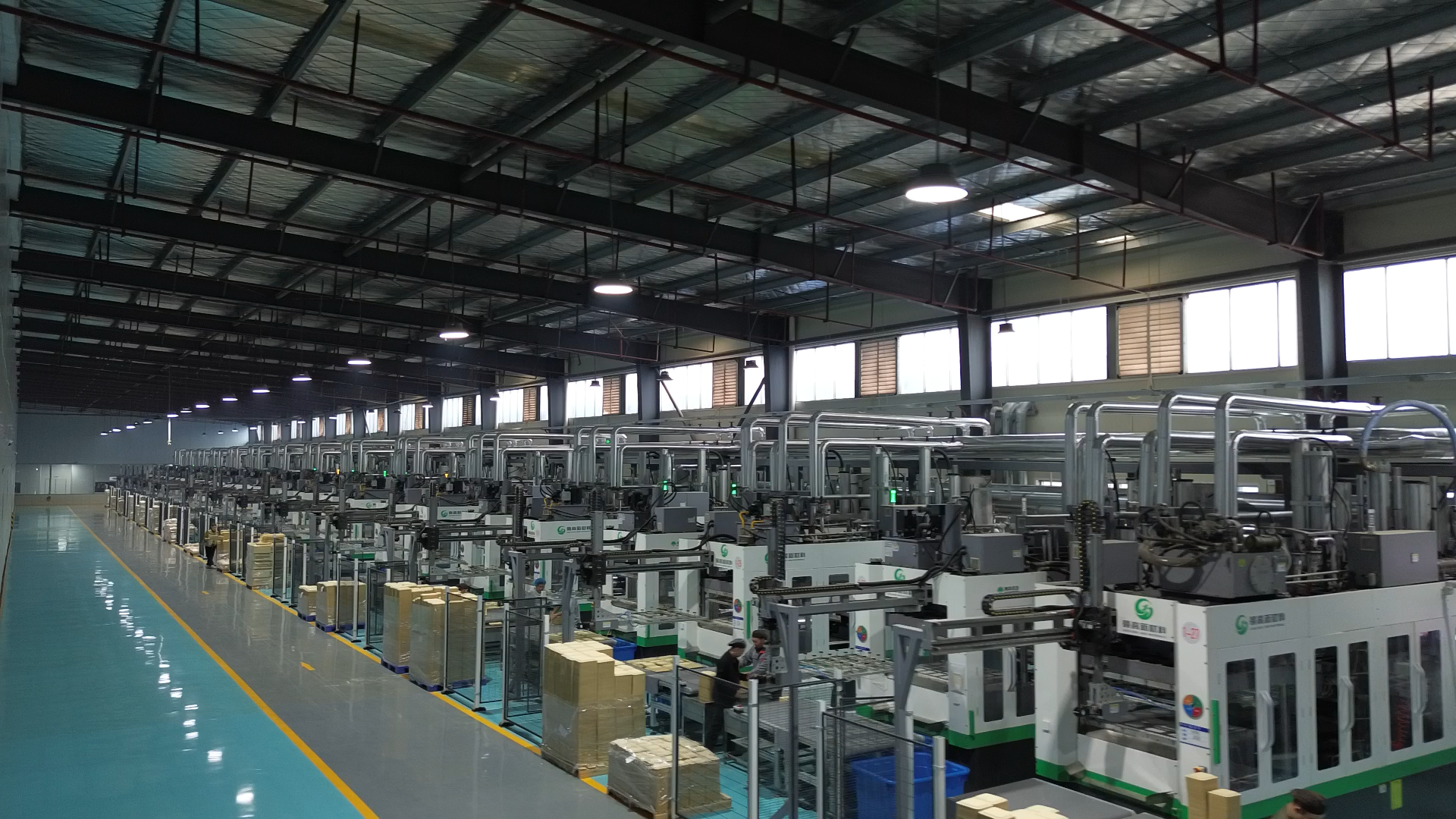
A turnkey pulp molding project ends with an installed, commissioned and staffed plant — not with equipment delivery.
Most buyers enter this category by searching for a single machine, and then discover that the machine is only one of several systems that must agree with one another. A forming machine with the wrong platen size, a mold that cannot survive the move from prototype to volume production, or a pulp preparation system sized for the wrong number of stations will each cap output regardless of the quality of everything else. A turnkey project exists to remove those interfaces from the buyer’s risk list.
What “Turnkey” Really Covers — and Where the Grey Areas Sit
“Turnkey” describes a contract boundary, not a machine specification. Two suppliers can quote a “turnkey pulp molding plant” and mean very different things: one includes mold design and manufacturing, while another treats molds as a separate purchase; one plans the building layout and utility loads, while another ships the equipment and stops there.
Pulp molding makes this boundary problem unusually visible, because the variables that decide product quality are physically coupled. Fiber material, slurry concentration, feeding method, forming pressure, in-mold drying, hot-pressing pressure, trimming accuracy, inspection and packing all act on the same product in sequence. When each variable sits with a different vendor, the interfaces between them become the buyer’s problem to solve.
Six questions usually reveal how complete a turnkey scope really is:
- Who verifies that the intended raw material and product design can actually be formed at the required weight, thickness and surface quality?
- Who calculates production capacity — and who sizes pulp preparation, vacuum and compressed air to match it?
- Who designs the factory layout, including utility routing, floor loading and material flow?
- Who develops the molds, and who adapts them when the product moves from prototype to mass production?
- Who owns downstream automation such as trimming, vision inspection, stacking and packing, plus the electrical control system that connects them?
- Who trains the operators, and who stays on site until the line reaches stable output?
Practical test: a machine quotation answers “which machine.” A turnkey quotation answers all six questions in writing, before the order.
Industry Background: Why Turnkey Delivery Is Gaining Ground
Three market signals explain why the turnkey model attracts buyers who have never operated a molded fiber plant.
1. The equipment category is growing. The global pulp moulding machines market was valued at USD 2,140.0 million in 2024 and is projected to reach USD 3,760.2 million by 2032, expanding at a CAGR of 7.3% between 2025 and 2032 (Cloud Market Reports, 2025). Market-size figures deserve care: some reports group all paper-making machinery under “pulp molding,” which produces estimates several times higher than molding-machine-specific figures. The reliable reading is directional growth, not a precise number.
2. Demand is concentrated in foodservice packaging. Food and beverage packaging accounts for approximately 45% of global demand for pulp moulding machines, led by cup, tray and bowl formats (Cloud Market Reports, 2025). That concentration matters to project planning, because tableware lines carry different platen, trimming and stacking requirements from industrial protective packaging lines.
3. Supply is concentrated in a small number of exporting regions. China’s exports of machinery for making paper or paperboard (HS 843920) were valued at USD 49.58 million in 2024 (World Integrated Trade Solution / World Bank). For an overseas buyer, the practical question is therefore not whether suppliers exist, but which one remains accountable six months after commissioning.
Hanson’s delivery footprint follows that pattern. The company reports that export business accounts for 50% of total sales, with markets that include Mexico, Brazil, Vietnam, Thailand, Indonesia, Malaysia, India, Turkey, Egypt, Saudi Arabia, the United Arab Emirates, Italy, Romania, Russia, Argentina, Peru and Australia, supported through a service network of 10 locations.
The 6+1 Framework at a Glance
Hanson’s turnkey scope can be read as six modules that together deliver a working plant, plus one integration layer that prevents them from behaving like six separate contracts. The table below summarizes the structure before the modules are examined individually.
| Module | What it covers | What it decides for the buyer |
|---|---|---|
| 1. Project definition and planning | Preliminary product and raw-material verification, project feasibility analysis, production-capacity planning, factory layout design | Whether the product can be formed at target weight and thickness, and whether the building supports the line |
| 2. Pulp preparation | Intelligent pulp preparation systems: pulping, refining, slurry preparation and slurry feeding | Weight consistency, contamination risk, continuous slurry supply to forming stations |
| 3. Forming and hot pressing | Pulp molding forming equipment: integrated machines and multi-station lines with in-mold drying and electric, oil or steam heating | Cycle time, platen size, maximum product height and weight per mold, installed power |
| 4. Mold design and manufacturing | Independent mold division: product development, mold design, mold manufacturing, mold testing, mass-production adaptation, plus optimization of existing molds | Product geometry, tooling cost, and how fast a design moves from prototype to volume |
| 5. Downstream automation and control | Trimming, vision inspection, automatic stacking, packing, and electrical control systems (PLC and touchscreen; DCS/MCC on larger lines) | Yield, labor per shift, defect control, counting accuracy |
| 6. Installation, commissioning and ramp-up | Installation and commissioning, personnel training, production ramp-up support, resident engineers, spare parts and on-site service via 10 service locations | Time from delivery to stable mass production |
| +1 Integration and optimization layer | Joint optimization of molds, equipment, pulp preparation and production processes; utilities including vacuum, compressed air, cooling water, high-pressure mold washing, water treatment and energy management | Whether the six modules behave as one system instead of six purchase orders |
Step-by-Step: What Each Module Actually Delivers
Module 1 — Project Definition: Product, Raw Material, Capacity and Layout
Turnkey work begins before any steel is cut. Hanson’s project scope starts with preliminary product and raw-material verification, project feasibility analysis, production-capacity planning and factory layout design.
Each step removes a specific risk. Product and raw-material verification establishes whether the intended item — a plate, a bowl, a cup lid, a protective packaging insert — can be formed at the target weight, thickness and surface quality with the fiber the buyer plans to use. This matters because fiber materials behave differently during forming: bagasse, bamboo and other agricultural fibers, and recycled paper grades each affect drainage, wet-preform strength and drying behavior.
Capacity planning converts a sales target into equipment count and utility demand. Factory layout design then translates that result into a building: machine positions, material flow, maintenance access, and routing for vacuum, compressed air, cooling water, high-pressure mold-washing water and water treatment.
Floor loading belongs here too, and it is routinely underestimated. A ZAP-9585 large-format industrial packaging machine requires a floor load of 2,449 kg/m², while the more compact ZAD-8565 requires 1,990.5 kg/m². A layout that ignores these figures becomes a construction problem.
Module 2 — Pulp Preparation: Where Weight Consistency Is Decided
Slurry is the least visible module and often the most consequential. Pulp preparation covers pulping, refining, slurry preparation and slurry feeding — the systems that turn fiber, water and additives into a repeatable mixture and deliver it to every forming station at a stable concentration.
Two feeding philosophies appear across Hanson’s equipment range, and the choice affects contamination risk and weight variation:
- Circulating slurry feeding with slurry return is used on the ZAMS-6047 sampling line, where flexible, intermittent operation matters more than continuous volume.
- Quantitative slurry injection and continuous internal-circulation feeding are used on production machines such as the ZCE-1111, ZFG-1111 and ZBG-1111. Quantitative injection reduces product weight variation and removes the conventional slurry-return cycle, which helps prevent slurry deterioration and contamination. On the ZAP-9585, precise self-circulating slurry feeding with dynamic replenishment serves the same purpose for heavier industrial packaging products.
The practical consequence for buyers: weight variation is often discussed as a molding problem, but it is frequently a feeding problem. A machine specification that does not describe how slurry reaches the mold cavity is incomplete.
Module 3 — Forming and Hot Pressing: The Visible Heart of the Line
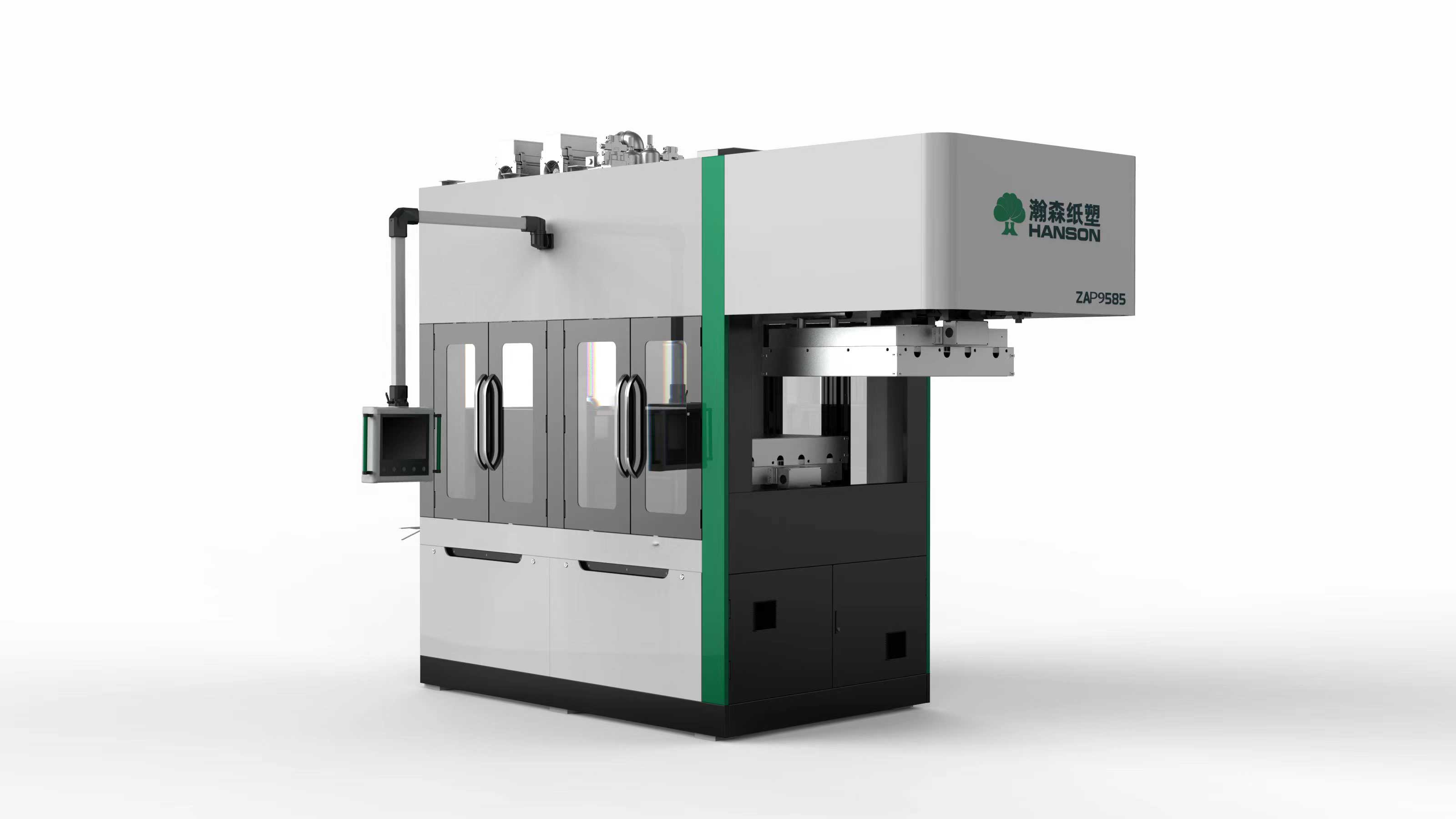
Module 3 in practice: the ZAP-9585 large-format industrial packaging machine uses a 950 × 850 mm platen with 10 tons of forming pressure and 40 tons of hot-pressing pressure.
Forming equipment is what most buyers picture when they search for a fully automatic pulp molding machine, and it is the module with the widest spread of configurations.
Hanson’s range covers integrated machines, in which forming and hot pressing share a single frame, and multi-station lines, in which forming, hot pressing and trimming are separate stations connected by transfer systems. Integrated designs such as the ZCE-1111 combine forming, hot pressing, trimming, counting and stacking in one unit and use a frame-type structure suited to installations with limited floor space. Line configurations such as the ZFG-1111 and ZBG-1111 separate stations to raise capacity.
Key selection variables, all of which appear on the datasheets:
- Mold platen size: from 600 × 470 mm on the ZAMS-6047 sampling line, through 850 × 650 mm (ZAD-8565) and 950 × 850 mm (ZAP-9585) for industrial packaging, to 1,100 × 1,100 mm on the tableware machines ZCE-1111, ZFG-1111 and ZBG-1111.
- Forming and hot-pressing pressure: forming pressure ranges from 2 tons on the sampling line to 20 tons on the ZCE-1111; hot-pressing pressure runs from 13 tons up to 120 tons on the ZFG-1111.
- Drying and heating: Hanson tableware and industrial packaging machines use in-mold drying with electric heating, while the ZFG-1111 can be configured with electric or oil heating and the ZBG-1111 supports oil, electric or steam heating.
- Maximum product geometry: up to 120 mm product height on the industrial packaging machines and 80 mm on the tableware machines.
Module 4 — Mold Design and Manufacturing: The Module That Sets the Pace
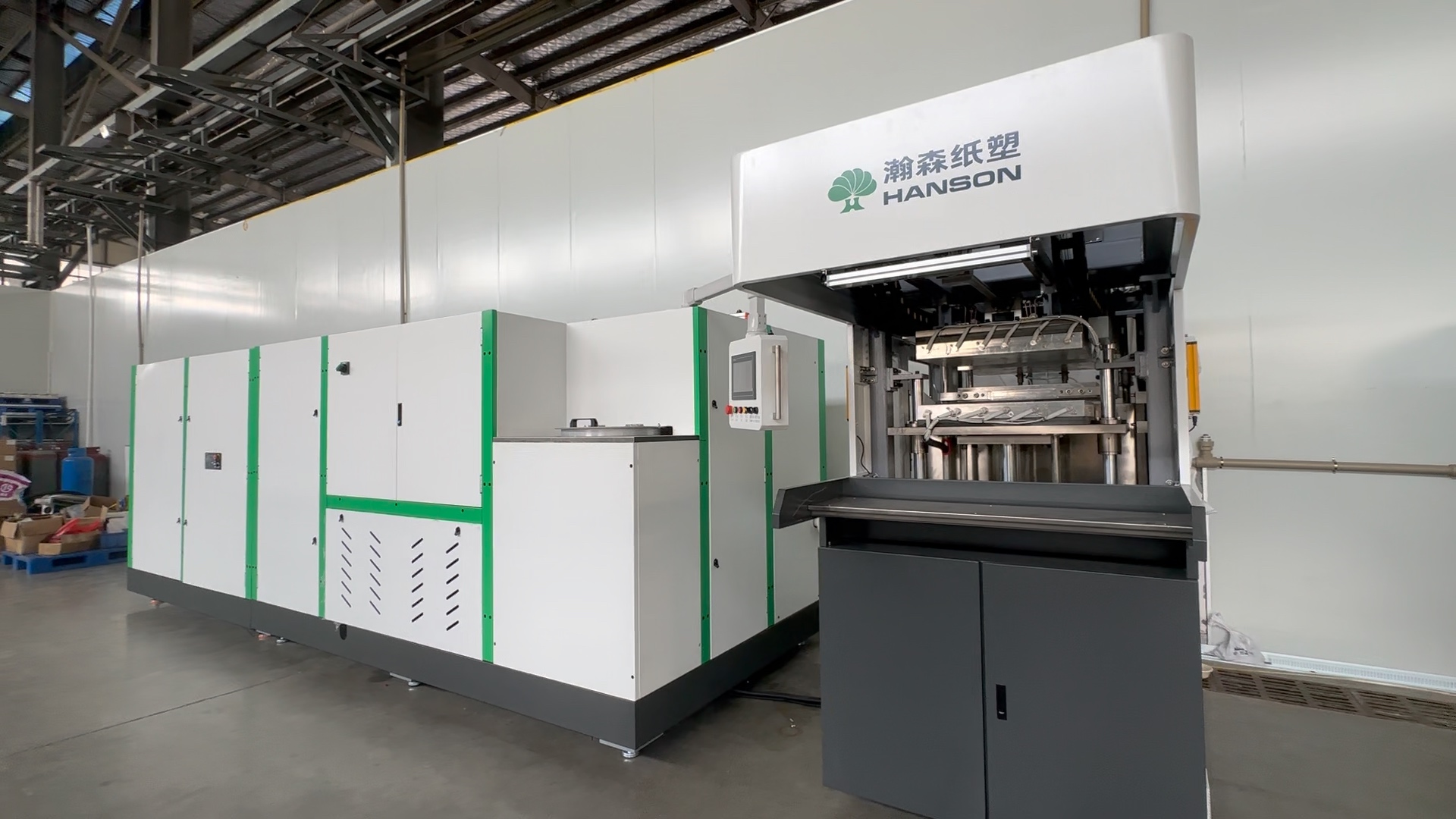
Module 4 support tooling: the ZAMS-6047 sampling line validates mold design and process parameters before volume tooling is committed.
Molds determine what a line can produce, how much tooling costs, and how quickly a design moves from concept to volume. Hanson operates an independent mold division with capabilities covering product development, mold design, mold manufacturing, mold testing and mass-production adaptation. The company also provides optimization services for existing molds and technical retrofits for existing equipment.
Two decisions inside this module have direct commercial effects:
- Molds per cycle. The ZCE-1111 integrated tableware machine requires six molds, which lowers mold investment and replacement cost compared with layouts that use more cavities.
- Layout flexibility on a large platen. On the ZAP-9585, a 950 × 850 mm platen can host combinations of smaller molds, allowing several product variants to share one machine and reducing total mold investment.
Mold material matters as well: Hanson machines are specified with molds in national-standard 6061 aluminum alloy, and the company holds 50 patents covering equipment structures, production processes, automation systems and related technologies.
Module 5 — Downstream Automation and Control: Trimming, Inspection, Stacking and Packing
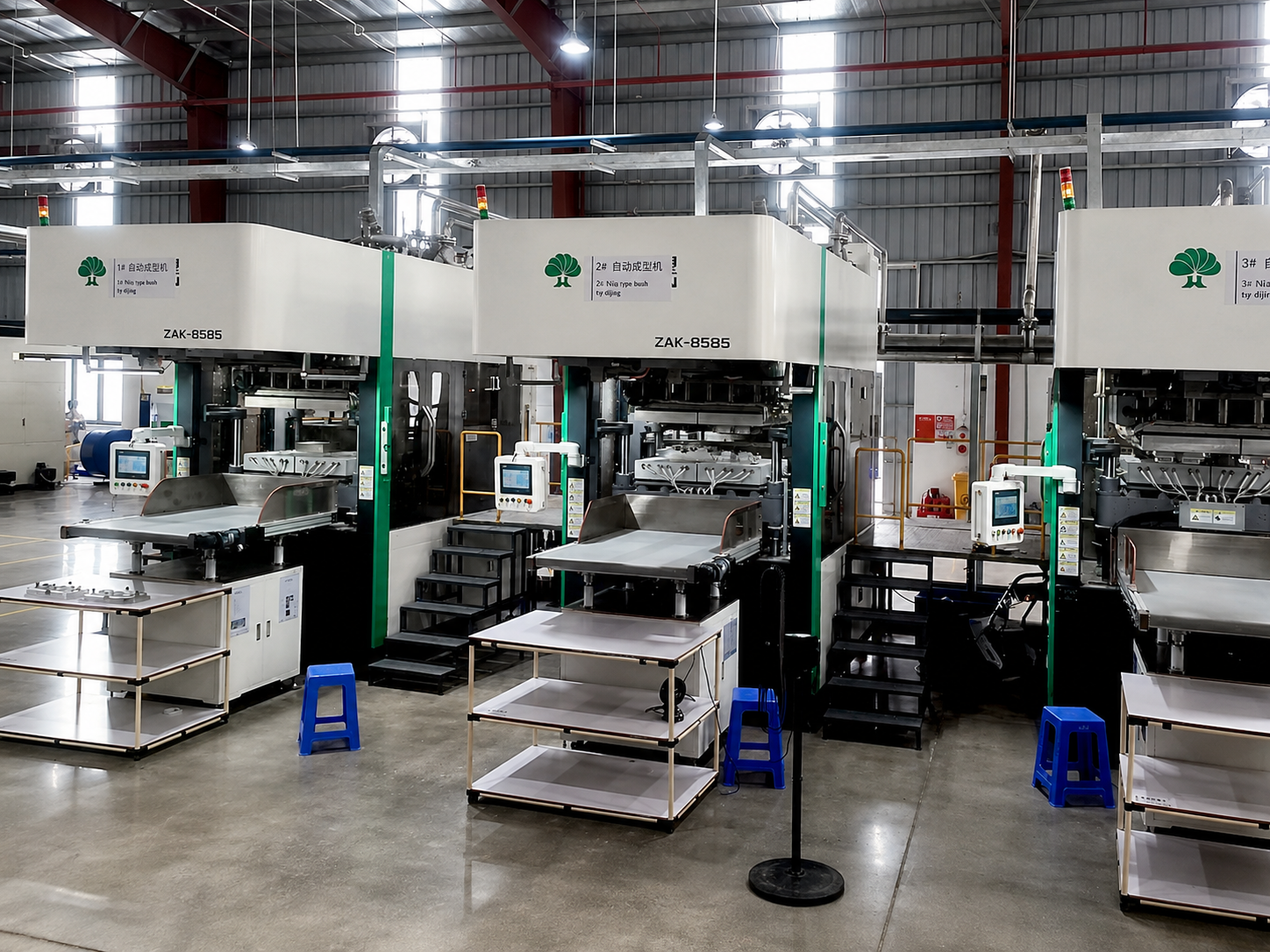
Module 5 in a real plant: molded fiber protective packaging produced on a ZAD-8565 compact industrial packaging machine.
Forming and pressing produce a product; downstream automation produces a sellable one. Hanson’s downstream scope covers trimming, vision inspection, automatic stacking, packing and the electrical control systems that connect them.
The ZAKS-9595 cup lid line shows what this module looks like in practice. It integrates forming, hot pressing, trimming, vision inspection and packaging in one line, with a trimming mold platen of 500 × 600 mm, 50 tons of trimming pressure and a trimming cycle of 10 seconds per mold. Vision inspection runs at 0.5 mm accuracy across multiple cameras and angles, and an automatic rejection device removes nonconforming products. Servo-controlled packaging performs automatic counting and supports lid diameters of Ø80 mm and Ø90 mm with a maximum packaging length of 400 mm.
Across the tableware range, trimming pressure reaches 70 tons on the ZCE-1111 and 80 tons on the ZFG-1111 and ZBG-1111, with stacking heights up to 200 mm including product height. Control is handled through PLC and touchscreen systems, with DCS/MCC control available on larger lines, so operators work from a control interface rather than from individual machine panels.
Module 6 — Installation, Commissioning, Training and Ramp-Up
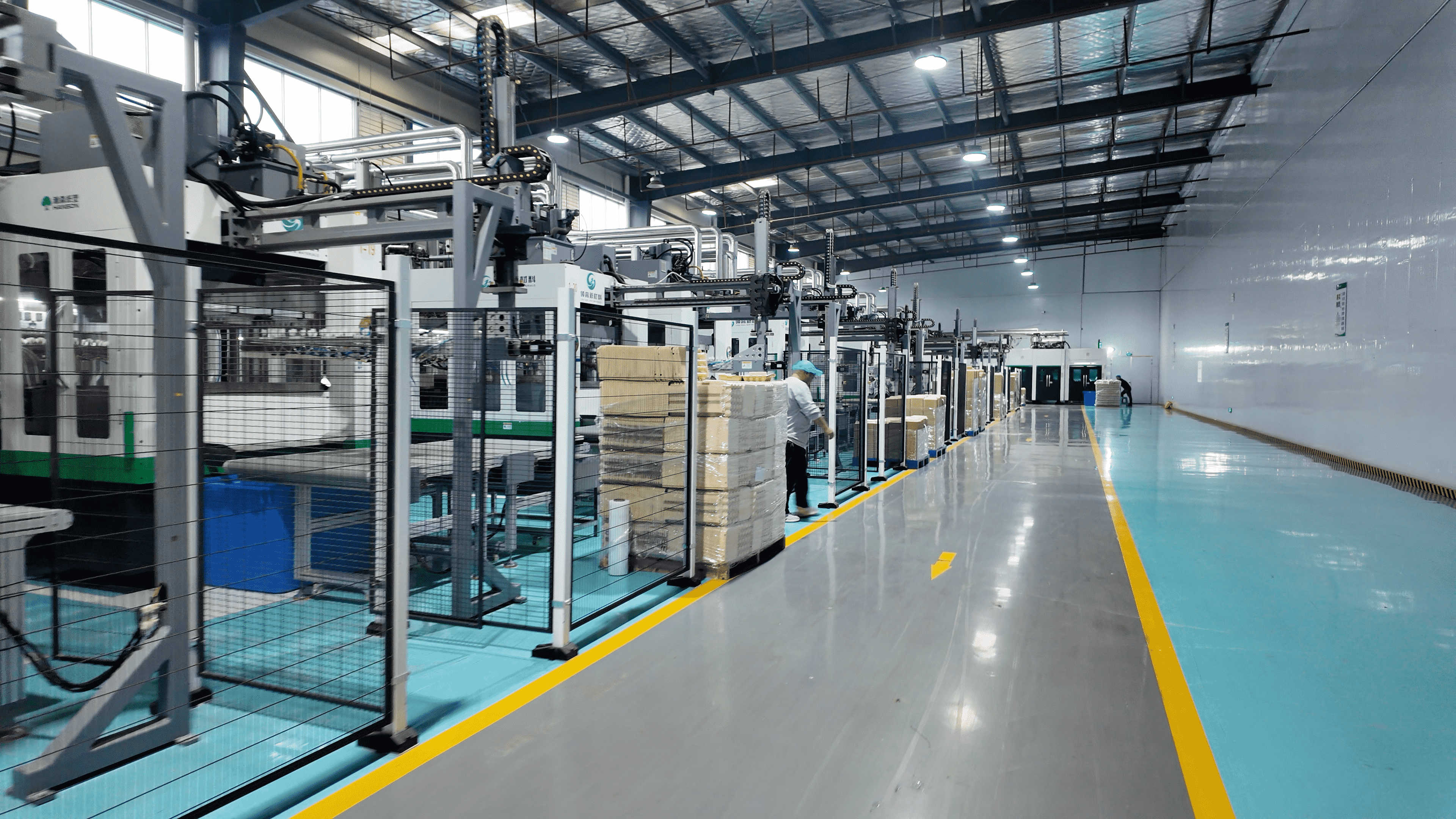
Module 6: ramp-up support continues after commissioning until output parameters are stable.
Commissioning is the point at which a project either becomes a factory or becomes a dispute. Hanson’s service scope covers installation and commissioning, personnel training, production ramp-up support, spare parts and on-site project services, delivered through a service network of 10 locations across key domestic and overseas markets.
For turnkey projects, the company can arrange resident engineers and provide production ramp-up and on-site production support. This addresses the most common failure mode in new molded fiber plants: equipment that runs, but output that is not yet stable. Training belongs to the same module, because operator decisions on slurry concentration, cycle adjustment and mold cleaning directly affect yield.
The “+1” — The Integration Layer That Turns Six Modules Into One System
The plus-one is not a service line on a quotation; it is the coordination that must exist across the other six. In Hanson’s delivery model it appears as joint optimization of molds, equipment, pulp preparation and production processes, with the stated objective of improving production capacity, product yield and overall production stability.
Practically, the integration layer covers the utilities every module depends on:
- Vacuum: typically -0.07 to -0.05 MPa on industrial packaging machines, and -0.06 to -0.05 MPa on tableware lines.
- Compressed air: 0.5–0.6 MPa on the cup lid line and 0.5–0.8 MPa on tableware lines.
- Cooling water: 60–80 L/min on the compact ZAD-8565 and 80–100 L/min on the ZAP-9585 and ZAKS-9595.
- High-pressure mold-cleaning water: 1.2 MPa across the range.
- Water treatment and energy management systems, plus DCS/MCC control on larger projects.
These figures are the reason the integration layer cannot be left until the end of a project. A cup lid line whose forming module alone has an installed power of 126.45 kW needs its electrical, compressed-air and cooling provisions planned when the building layout is drawn — not when the equipment arrives on site.
Equipment Reference: Matching Modules to Product Type
The table below compares Hanson’s current pulp molding machines and lines on the specifications that most often decide a project.
| Model | Type | Key specifications | Output and product limits |
|---|---|---|---|
| ZAMS-6047 | Fully automatic integrated sampling and small-batch production line | Platen 600 × 470 mm; forming 2 t (electric cylinder); hot pressing 13 t (hydraulic); 82 kW; electric heating; no trimming function | Prototyping and small-batch molded fiber packaging; max product height 120 mm; 200 g per mold at 0.3% slurry concentration |
| ZCE-1111 | Fully automatic integrated tableware machine | Platen 1,100 × 1,100 mm; 6 molds; forming 20 t; hot pressing 60 t; trimming 70 t; 167.4 kW | 600–900 kg/24 h; forming cycle 28–60 s per mold; max product height 80 mm |
| ZFG-1111 | Fully automatic inline servo tableware production line | 1 forming + 1 hot-pressing (120 t) + 1 trimming (80 t) + transfer and stacking; 102 kW with electric heating, 39 kW with oil heating | 900–1,200 kg/24 h; platen 1,100 × 1,100 mm; max product height 80 mm |
| ZBG-1111 | Fully automatic robotic tableware production line | 1 forming + 2 hot-pressing + 1 trimming; six-axis robot, 2,700 mm reach and 300 kg payload; 60 kW; oil, electric or steam heating | 1,000–1,500 kg/24 h; platen 1,100 × 1,100 mm; max product height 80 mm |
| ZAP-9585 | Large-format industrial packaging integrated machine | Platen 950 × 850 mm; forming 10 t; hot pressing 40 t; 114 kW; floor load 2,449 kg/m² | Max product height 120 mm; 900 g per mold at 0.3% slurry concentration |
| ZAD-8565 | Compact industrial packaging integrated machine | Platen 850 × 650 mm; forming 3 t; hot pressing 20 t; 54.1 kW; floor load 1,990.5 kg/m² | Max product height 100 mm; 500 g per mold at 0.3% slurry concentration |
| ZAKS-9595 | Fully automatic cup lid production line | Forming platen 950 × 950 mm; trimming platen 500 × 600 mm, 50 t, 10 s per mold; vision accuracy 0.5 mm | Lid sizes Ø80 mm and Ø90 mm; maximum packaging length 400 mm |
Use Cases: Which Configuration Fits Which Project
Biodegradable tableware in a new factory. A buyer entering foodservice packaging with a defined product range typically chooses between the ZCE-1111 integrated machine and the ZFG-1111 or ZBG-1111 production lines. The ZCE-1111 produces 600–900 kg per 24 hours and needs only six molds, which suits a compact footprint; the ZBG-1111, with two hot-pressing stations and a six-axis transfer robot, reaches 1,000–1,500 kg per 24 hours for higher-volume projects.
Industrial protective packaging. Molded fiber inserts for consumer electronics, appliances and premium goods require larger platens and greater product depth. The ZAP-9585 handles products up to 120 mm high and up to 900 g per mold on a 950 × 850 mm platen. The compact ZAD-8565 handles up to 100 mm and 500 g per mold on an 850 × 650 mm platen and is intended for factories with limited production space.
Plant-fiber cup lids. Lid production adds cleanliness, dimensional and inspection requirements that tableware lines do not carry. The ZAKS-9595 is purpose-built for this application, combining forming, hot pressing, servo trimming, multi-camera vision inspection, automatic rejection, counting and packaging for Ø80 mm and Ø90 mm lids.
Product development and pilot production. Before committing volume tooling, the ZAMS-6047 sampling line integrates pulping, refining, slurry preparation, slurry feeding, forming and hot pressing in a single machine. It supports molded fiber packaging R&D, small-batch production and material testing, and is used by packaging companies, research institutes and universities.
What to Request in Writing for Each Module
Because turnkey boundaries differ between suppliers, the most reliable way to compare offers is to ask for module-level evidence. The checklist below maps each module to the documents that make scope verifiable.
| Module | Documents or evidence to request |
|---|---|
| 1. Project definition | Raw-material and product verification result; capacity calculation; layout drawing with utility routing and floor-loading figures |
| 2. Pulp preparation | Slurry system schematic; feeding method (circulating with return versus quantitative injection or continuous internal circulation); water treatment and cleaning provisions |
| 3. Forming and hot pressing | Equipment datasheet stating platen size, forming and hot-pressing pressure, heating method, installed power and floor load |
| 4. Mold design and manufacturing | Mold design drawings; mold material specification (for example, national-standard 6061 aluminum alloy); mold test record; plan for mass-production adaptation |
| 5. Downstream automation and control | Trimming pressure and cycle figures; vision inspection accuracy and rejection logic; counting method; control architecture (PLC and touchscreen, DCS/MCC where applicable) |
| 6. Installation, commissioning and ramp-up | Commissioning checklist; operator training plan; ramp-up plan and resident-engineer arrangement; spare parts list; safety documentation covering protective doors and safety light curtains |
| +1 Integration layer | Utility schedule covering vacuum, compressed air, cooling water and high-pressure mold-washing water; scope of water treatment and energy management |
Frequently Asked Questions
What safety and standards documentation should a pulp molding turnkey project include?
For markets that apply European machinery safety standards, the safety-related parts of machinery control systems are covered by EN ISO 13849-1. The previous edition, EN ISO 13849-1:2015, will be withdrawn after a transition period ending 15 May 2027, so a project that specifies this standard should reference the current edition and confirm it in the contract. Independently of region, buyers should request electrical drawings, the safety-device configuration, function descriptions and the risk-reduction measures built into the machine. Hanson forming equipment such as the ZAMS-6047 and ZAP-9585 is documented with protective doors and safety light curtains. Because the applicable rule set depends on the destination market and on the buyer’s own compliance obligations, the document list should be agreed in writing before the order is placed.
What does a pulp molding machine manufacturer actually provide in a turnkey project?
Beyond the forming machine, a complete turnkey scope covers six modules plus one integration layer: project definition (product and raw-material verification, feasibility analysis, capacity planning and factory layout design); pulp preparation; forming and hot-pressing equipment; mold design and manufacturing through an in-house mold division; downstream automation and electrical control covering trimming, vision inspection, stacking, packing and PLC/touchscreen or DCS/MCC control; and installation, commissioning, training and ramp-up support. Hanson delivers these with approximately 50 R&D engineers, an independent mold division, 50 patents and 10 service locations, and can arrange resident engineers for turnkey projects. A supplier that offers only the machine leaves modules one, two, four and six to the buyer.
What drives the investment level of a turnkey pulp molding production line?
No single factor sets the figure; five equipment-side variables do most of the work. Platen size establishes how much product can be formed per cycle, ranging from 600 × 470 mm on the ZAMS-6047 to 1,100 × 1,100 mm on the tableware machines. Station count and automation level change capacity and labor: the ZFG-1111 uses one forming, one hot-pressing and one trimming station, while the ZBG-1111 adds a second hot-pressing station and a six-axis transfer robot. Molds per cycle affect tooling cost, as with the six-mold layout of the ZCE-1111. Heating method affects electrical planning, since the ZFG-1111 is rated 102 kW with electric heating and 39 kW with oil heating. Machine mass and floor loading affect civil works: the ZAP-9585 requires 2,449 kg/m² against 1,990.5 kg/m² for the ZAD-8565. Buyers should convert these variables into their own cost model rather than comparing headline prices alone.
Can I validate a product before installing a full turnkey line?
Yes. The ZAMS-6047 sampling production line is designed for exactly this purpose. It integrates pulping, refining, slurry preparation, slurry feeding, forming and hot pressing in one machine, with a 600 × 470 mm mold platen, 2 tons of forming pressure, 13 tons of hot-pressing pressure and in-mold drying with electric heating. It is intended for pulp molding product development and prototyping, molded fiber packaging research and development, and small-batch molded fiber packaging production. Its limits should be understood up front: it does not include trimming, the maximum product height is 120 mm, and the maximum product weight per mold is 200 g at 0.3% slurry concentration. Those constraints suit prototype and pilot work; volume tooling on a production line remains a separate step.
How does a turnkey project move from installation to stable mass production?
The transition is managed through commissioning, operator training and ramp-up support. Hanson provides installation and commissioning, personnel training, and production ramp-up with on-site production support, with the option of resident engineers for turnkey projects and spare parts and technical support through its 10 service locations. Because capacity planning, utilities and mold adaptation were settled in earlier modules, ramp-up focuses on stabilizing slurry parameters, cycle settings and inspection standards rather than on correcting layout problems. Buyers preparing for this stage can request a project consultation, a sample validation arrangement or the Hanson Pulp Molding product catalog by contacting linchuangcheng@hspulpmolding.com or +86 159-2060-4830.
Conclusion: Turnkey Means One System, Not Six Purchase Orders
A turnkey pulp molding solution is best understood as six modules plus one integration layer: project definition, pulp preparation, forming and hot pressing, mold design and manufacturing, downstream automation and control, and installation with ramp-up — coordinated so that utilities, molds, equipment and process settings are optimized together rather than purchased separately.
For buyers at the awareness and research stage, the practical takeaway is a question set rather than a machine list. Ask which modules a supplier owns, which documents exist for each module, and who remains on site until output is stable. Those three questions separate a genuine turnkey project from a machine sale.
HANSON PULP MOLDING TECHNOLOGY CO., LTD. is a National High-tech Enterprise based in Dongguan, Guangdong, China, specializing in pulp molding equipment, production lines and turnkey factory solutions. The company operates a 50,000 m² manufacturing facility with approximately 200 employees and an annual capacity of 150 units of pulp molding equipment, holds 50 patents, and works with a customer base that includes Home-Link, Shengquan Group, Anhui Fengyuan, Guangxi Qiaowang, Gaoyi Packaging, YUTO, Yongfa Printing, Solenis and Sichuan Jinzhu.
Next Step
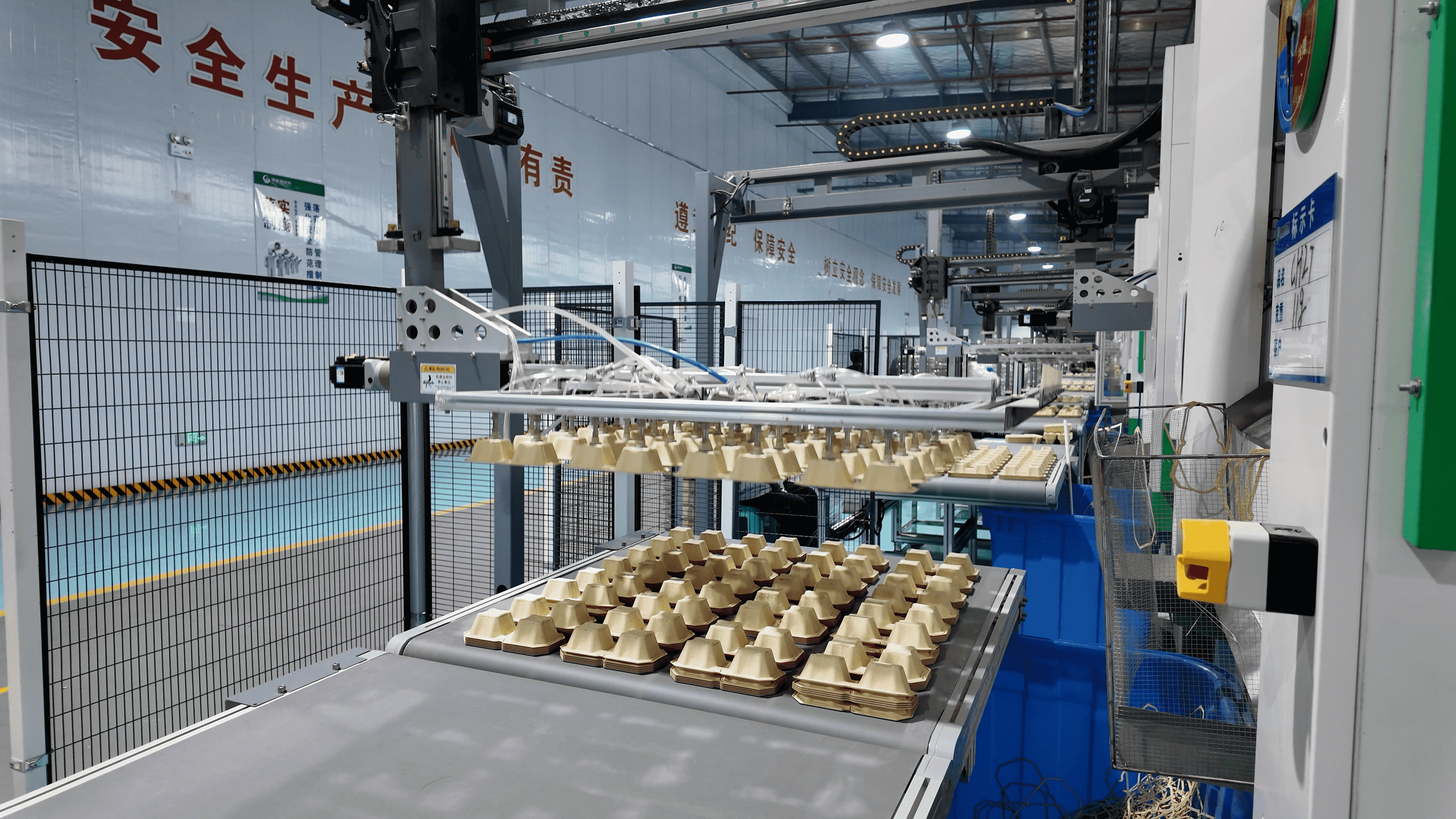
If you are planning a molded fiber plant, Hanson can review your product, raw material and capacity target, then map your project against the six modules and the integration layer described above.
Catalog download:Hanson Pulp Molding product catalog (PDF)
Company website:www.hspulpmolding.com
Email: linchuangcheng@hspulpmolding.com
Phone / WhatsApp: +86 159-2060-4830
Address: Room 101, No. 6, Lane 1, Fourth Industrial Zone, Qiaotou, Houjie Town, Dongguan City, Guangdong Province, China
Have Questions or Need More Details?
Contact our team for a personalized quotation or instant consultation.
Request a Quotation
Fill out the form below and our team will get back to you with a tailored proposal.
WhatsApp Direct Chat
Prefer to chat in real-time? Message us on WhatsApp for instant assistance & quick answers.
- Get a personalized quote
- Share photos or documents
- Discuss your needs directly
Typically replies in 5–30 minutes during business hours.