
Pulp Molding Machine Downstream Automation Cycle Mismatch
A downstream automation cycle mismatch occurs when the equipment after the forming machine — transfer, trimming, vision inspection, stacking or packing — cannot hold the takt set upstream. The forming machine keeps producing, but the line stops behaving like one machine: semi-dry products queue before trimming, automation idles between mold shots, operators step in to clear accumulation, and the line never reaches the output it was specified at. On pulp molding projects the cause is usually planning rather than hardware: forming equipment, downstream automation, electrical control and utilities were bought as separate scopes, each with its own cycle assumption. This guide explains how the mismatch develops, how to test for it before purchase, and how an integrated pulp molding tableware production line and turnkey project interface keep the whole rhythm — slurry to packed product — under one plan.
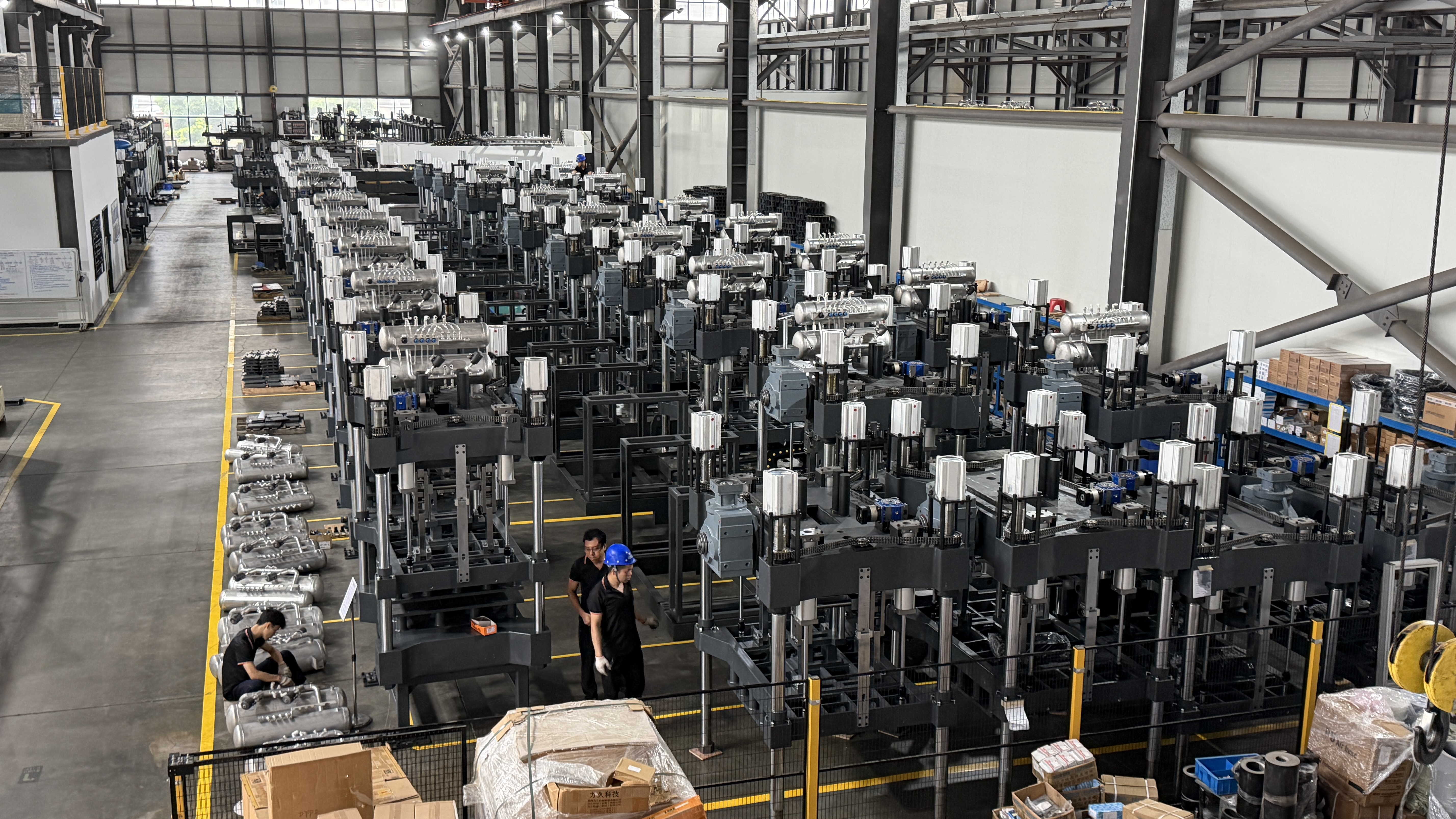
Problem Definition: What a Cycle Mismatch Actually Is
Cycle mismatch is a rhythm defect, not a component defect. Every station on a pulp molding line has a cycle. The forming machine closes, dewaters, transfers the wet preform and returns. The trimming station opens, cuts, ejects and returns. Vision inspection, counting and packing each add handling time. When those cycles are close but not equal — and no buffer has been designed to absorb the difference — the slowest station sets the output and the fastest station spends part of every cycle waiting.
Two failure patterns dominate in practice:
- Downstream slower than forming. Wet or semi-dry preforms accumulate between the forming machine and the trimming press. Operators begin clearing the queue by hand. Products are handled more often than the process was designed for, and handling becomes a quality variable.
- Downstream faster than forming. Trimming, inspection or packing runs starved, waiting for product that has not yet been formed. The automation is technically capable but operates on a duty cycle nobody planned, and per-shift output stays below the reference figure.
Symptoms that point to a cycle problem rather than a machine fault
- Output stays under the reference capacity even when the forming machine runs at its rated setting.
- Operators regularly intervene between forming and trimming, or between trimming and packing.
- The line runs smoothly for a period and then stalls in a repeating pattern across the shift.
- Speed is raised to close the gap, and product quality or reject rate moves in the wrong direction.
- Restart after a stop produces a burst of rejected parts at inspection.
- Vacuum or compressed-air alarms appear at rhythm changes rather than at steady state.
The reason this survives the purchase stage is structural. Each supplier quotes against its own datasheet, and each datasheet is internally consistent. The forming machine meets its cycle. The trimming press meets its cycle. The fault appears only in the handshake between them — which belongs to no single datasheet.
Industry Background: Why Lines Get Assembled From Separate Cycles
Demand for molded fiber equipment has grown fast enough that capacity planning often outpaces line-architecture planning. The global pulp moulding machines market was valued at USD 2,140.0 million in 2024 and is projected to reach USD 3,760.2 million by 2032, according to Cloud Market Reports. Within that demand, food and beverage packaging accounts for approximately 45% of global demand, with cup, tray and bowl formats leading — formats where trimming, counting and packing rhythm decide usable output. On the supply side, China's exports under HS 843920 (machinery for making paper or paperboard) were valued at USD 49.58 million in 2024, per World Integrated Trade Solution data.
Commercially, a new plant is often assembled in slices: the forming machine from a machine manufacturer, trimming and packing from an automation integrator, pulp preparation from a third supplier, and utilities from a local contractor. Each slice is defensible on price. What is not assigned to anyone is the interface rhythm — who adjusts the transfer window, who owns the accumulation logic, and who is responsible when the trimming cell and the forming machine disagree by a few seconds per cycle.
Compliance adds a second layer to the same problem. Safety-related parts of machinery control systems must comply with EN ISO 13849-1, and the 2015 version of that standard is withdrawn after a transition period ending 15 May 2027. On an integrated line, a trimming press, a transfer device and a packing station share one safety architecture with the forming machine. When downstream automation is added later from a different supplier, that architecture has to be re-designed and re-validated, which is a coordination cost that rarely appears in the original equipment quotation.
The Three Rhythms That Must Agree
1. The forming takt
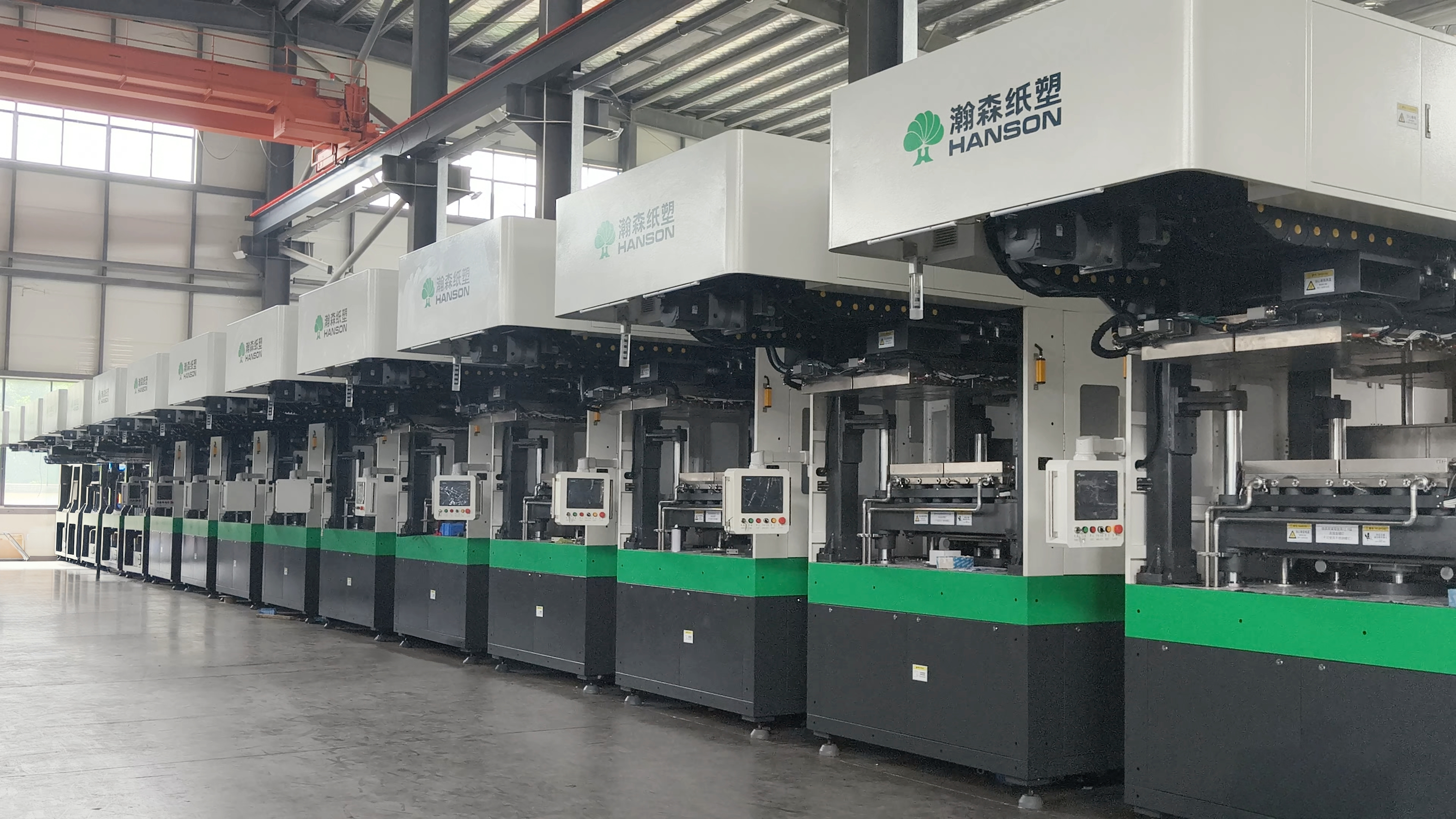
The forming machine sets the master rhythm. Hanson's fully automatic food container machine is published with a cycle time of 28 seconds and up to 900 kg daily output. Output per cycle also depends on how many cavities the mold carries, so the same machine cycle can translate into different unit throughput once a mold layout is fixed. Reference capacities across Hanson configurations illustrate the spread: the full-servo ZFG-1111 at 900–1,200 kg/24 h, the separated modular ZBG-1111 at 1,000–1,500 kg/24 h, and the hydraulic ZCE-1111D at 600–900 kg/24 h — all depending on product, mold layout and process conditions.
2. The per-mold processing takt
Trimming, hot pressing and inspection work on a mold or a batch, not on a single item. The integrated cup lid line ZAKS-9595 is specified with a trimming cycle of 10 seconds per mold and a vision inspection accuracy of 0.5 mm. Those two numbers define what downstream can accept: a trimming cycle that is longer than the forming cycle builds inventory in front of the press, and an inspection accuracy that is tighter than the process can hold produces reject loops that consume the buffer.
3. The batch, packing and supply rhythm
Counting, stacking and packing operate in batches, and a mismatch there does not stop the line — it quietly absorbs labor. The same logic applies on the supply side. Vacuum, compressed air, heating, water circulation and slurry feeding all have their own response times. A precise slurry feeding design with internal circulation, which removes the external return-slurry loop entirely (0 return loops compared with at least one on a conventional return-slurry system), exists precisely so that slurry supply follows the actual forming rhythm instead of running continuously against it.
Why Integrated Planning Solves the Mismatch Better Than Retrofitting
The core difference between a turnkey project and fragmented procurement is not the equipment list. It is that the turnkey model integrates factory planning, pulp preparation, forming equipment, molds, downstream automation, electrical control, utilities, wastewater treatment, installation, commissioning and personnel training under one project-management system, whereas separate procurement requires the customer to purchase and coordinate these from multiple suppliers.
HANSON PULP MOLDING is a pulp molding equipment manufacturer based in Houjie Town, Dongguan City, Guangdong Province, China, founded in 2022, with more than 200 employees including approximately 50 R&D and engineering professionals, 50 patents, a 50,000 m² factory, an annual output of about 150 units and a 50% export ratio. Its turnkey solution covers 6+1 service modules under one integrated project interface: factory planning, pulp preparation, forming equipment, mold manufacturing, downstream automation, technical and production support, plus product development, raw-material development, sampling and small-batch validation.
Three mechanisms in that structure directly address cycle mismatch:
- One interface owns the rhythm. With a turnkey solution, one project team can coordinate troubleshooting across pulping, forming, molds, automation and utilities. With separate procurement, the customer may have to identify which supplier is responsible before a system-level problem can be solved at all.
- Servo control makes the rhythm adjustable. The full-servo solution uses digitally controlled servo systems for major movements, providing precise position control, flexible production rhythm and stable repeatability — the properties that make a transfer window tunable instead of fixed. Under comparable product and operating conditions, Hanson's full-servo solution can reduce comprehensive energy consumption by approximately 15%–25% compared with traditional solutions.
- Utilities are tuned to the line, not to a spec sheet. A turnkey project allows pulping, vacuum, compressed air, heating, water circulation and production rhythm to be optimized as one complete system, whereas separately purchased systems may each perform well while overall energy efficiency depends heavily on interface design and commissioning quality.
Commissioning is where the theoretical cycle becomes a real one. Hanson's resident on-site service covers equipment installation, utility connection, multi-system commissioning, process coordination, trial operation, operator training and project acceptance — a wider scope than short-term installation and commissioning, which generally ends after basic functional testing. Resident engineers can identify and resolve installation, electrical, utility, mechanical and process problems directly at the project site, whereas a commissioning-only model typically relies on remote support or separate service visits for later issues.
After commissioning, production ramp-up support continues to work on the rhythm itself: optimizing vacuum, compressed air, heating, slurry feeding and production rhythm under actual operating conditions. For turnkey projects, Hanson provides up to 6 months of production ramp-up and on-site support, depending on the contract and project requirements, whereas a standard short-term commissioning model ends after installation without a dedicated long-term ramp-up period.
Step-by-Step: Evaluating Cycle Compatibility Before You Buy
The evaluation can be done on paper before any equipment is ordered. The purpose is not to obtain a perfectly matched number — it is to force each supplier to state its cycle in the same unit and to assign ownership of the interface.
- Fix the product and the mold layout first. Product weight, geometry and cavity count convert machine cycle into unit throughput. Reference capacities for every Hanson line are quoted subject to product, mold layout and process conditions, which is exactly the variable that must be frozen before cycle comparison means anything.
- Write down the forming takt in seconds and the output in kg/24 h. Ask for both figures, plus the conditions they assume.
- Convert downstream modules to the same unit. A trimming cycle given as seconds per mold, a vision system given as millimetre accuracy, and a packing station given as items per minute cannot be compared until all three are converted into items per minute at the planned cavity count.
- Identify the slowest station and the difference to the forming takt. If the difference is not zero, decide deliberately whether it is absorbed by an accumulation buffer, by a dwell window in the transfer, or by accepting a lower line output.
- Decide inline versus modular before layout is frozen. The integrated inline ZFG-1111 occupies about 11,200 × 2,150 × 4,800 mm (approximately 24.1 m²), while the separated modular ZBG-1111 occupies about 6,100 × 6,500 × 3,600 mm (approximately 39.7 m²). Based on equipment dimensions, the integrated inline layout requires roughly 39% less floor area, while the modular layout offers higher reference capacity at 1,000–1,500 kg/24 h versus 900–1,200 kg/24 h. Both are available from Hanson and should be selected according to product type, capacity target, factory conditions and investment plan.
- Write the control interface into the contract. Specify the PLC handshake signals, safety-door interlocks, emergency stop chain, light curtains and guarded moving parts, overload protection, overcurrent and phase-loss protection, and pressure and vacuum monitoring, so that no station can start unexpectedly while another is being cleared.
- Match utilities to the matched rhythm. Vacuum level, compressed-air consumption, heating profile, water circulation and slurry supply must be sized to the line rhythm, not to the maximum of each individual machine.
- Plan commissioning and ramp-up as a separate phase with its own targets. Include trial operation, operator training and a defined ramp-up window, then use that window to adjust transfer timing, trimming parameters and inspection thresholds under real production conditions.
Where Cycle Matching Decides the Project: Four Use Cases
New bagasse tableware plant
Bagasse and other agricultural fiber projects typically start with a new factory, a new product and new operators at the same time. The full-servo tableware production line is the appropriate reference point here, because digitally controlled servo movements allow the production rhythm to be adjusted as the process stabilizes, instead of locking the line into one fixed timing on day one. A turnkey model is more suitable for new factories, large-scale projects, overseas projects and customers without an experienced pulp molding engineering team, whereas separate equipment procurement suits experienced manufacturers that already have mature pulping, process, engineering and project-management capabilities.
Plant-fiber cup lid production
Cup lids are a high-volume, cleanliness-sensitive product, and the mismatch risk sits between trimming and inspection. The fully automatic cup lid line integrates forming, hot pressing, servo trimming, vision inspection, defective-product rejection, counting and packing in one continuous process, whereas a separated solution requires multiple independent machines plus manual transfer, inspection, counting and packing between stages. With a trimming cycle of 10 seconds per mold and 0.5 mm inspection accuracy, the line's rhythm is defined at the trimming and inspection interface — which is why that interface should belong to one supplier.
Premium industrial packaging
For premium industrial packaging, appearance and dimensional requirements are strict, and stable repeat orders are the norm. Automatic integrated equipment automates forming, wet-preform transfer, in-mold drying and hot pressing within a single production process, whereas manual machines require operator participation in at least three major process steps. Where downstream handling damages corners or surfaces, cycle mismatch becomes a quality problem as much as an output problem.
Existing plant adding downstream automation
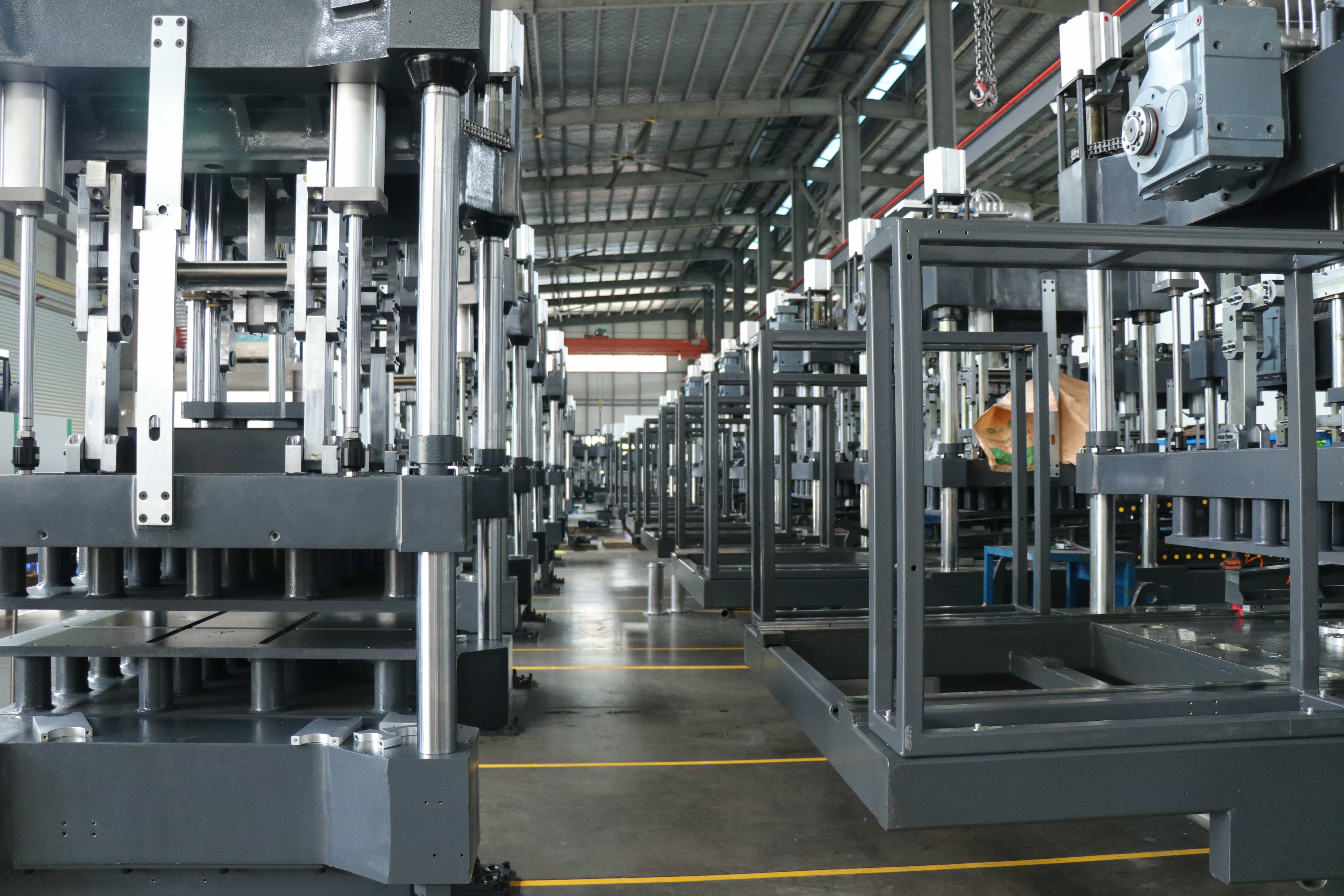
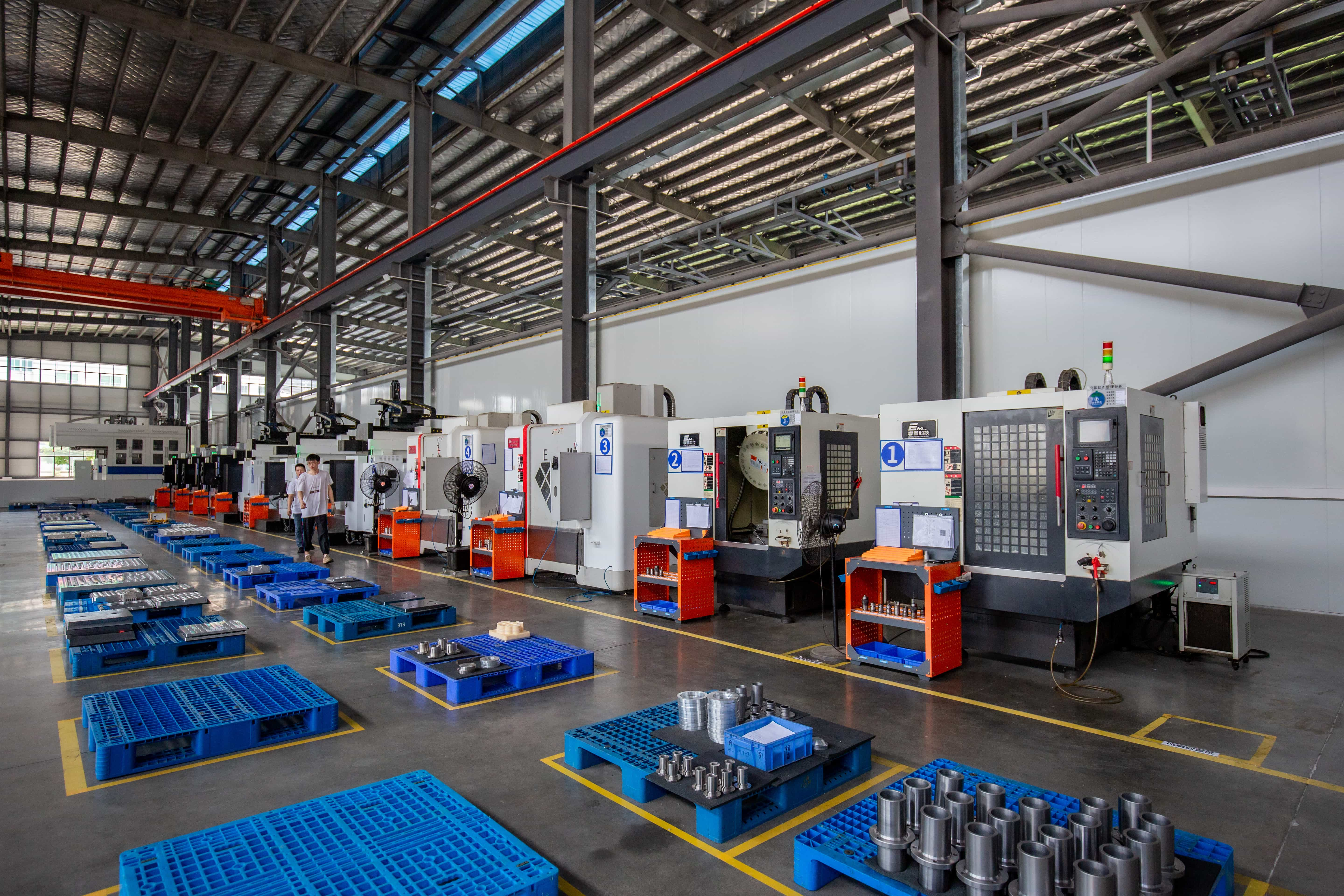
Brownfield projects carry the highest mismatch risk, because the forming machine is already fixed. Hanson operates an independent mold division with approximately 10 experienced mold designers and access to about 45 CNC machining centers, which gives direct engineering control over mold design, machining, testing, equipment adaptation and production optimization. Combined with mold optimization and equipment retrofit services, this is the practical route when the existing rhythm cannot be changed but downstream handling must be added.
Reference Configurations and Decision Tables
The following table summarizes how a single project interface compares with multi-supplier procurement on the points that determine whether cycle mismatch is caught before shipment. All statements reflect Hanson's published comparison positions.
| Decision area | Turnkey / single project interface | Separate equipment procurement |
|---|---|---|
| Scope ownership | Factory planning, pulp preparation, forming, molds, downstream automation, electrical control, utilities, installation, commissioning and training under one project-management system. | The customer purchases and coordinates these scopes from multiple suppliers. |
| Slurry and forming coordination | Hanson designs the pulp preparation system together with forming equipment, molds, slurry feeding, automation, utilities and process; concentration, flow, pipelines, tanks, white-water circulation and machine rhythm can be coordinated by one engineering team. | Pulping and forming sections come from different companies; the customer coordinates process parameters, control interfaces and system commissioning. |
| Cycle and interlock responsibility | One team owns the interface between forming and downstream automation, including multi-system commissioning and process coordination. | Interface faults require the customer to identify the responsible supplier before a system-level problem is resolved. |
| Commissioning depth | Resident on-site service covering installation, utility connection, multi-system commissioning, process coordination, trial operation, training and acceptance. | Short-term commissioning generally ends after installation and basic functional testing. |
| Ramp-up | Up to 6 months of production ramp-up and on-site support for turnkey projects, depending on contract and project requirements; optimization of vacuum, compressed air, heating, slurry feeding and production rhythm under actual conditions. | No defined ramp-up period; later issues handled through remote support or separate service visits. |
| Best fit | New factories, large-scale projects, overseas projects and customers without an experienced pulp molding engineering team. | Experienced manufacturers with mature pulping, process, engineering and project-management capabilities. |
Configuration choice also changes the cycle arithmetic. The table below lists reference figures as published, subject to product, mold layout and process conditions.
| Reference line | Layout | Reference capacity | Footprint | Cycle-relevant note |
|---|---|---|---|---|
| ZFG-1111 | Integrated inline, full servo | 900–1,200 kg/24 h | 11,200 × 2,150 × 4,800 mm (≈24.1 m²) | Compact route, reduced transfer distance and inter-station handling |
| ZBG-1111 | Separated modular | 1,000–1,500 kg/24 h | 6,100 × 6,500 × 3,600 mm (≈39.7 m²) | Higher reference capacity; efficiency depends on robot rhythm and station balance |
| ZCE-1111D | Hydraulic / pneumatic-hydraulic | 600–900 kg/24 h | — | Mature pressure structure; lower initial configuration cost depending on project scope |
| ZAKS-9595 | Integrated cup lid line | Trimming 10 s per mold; vision inspection accuracy 0.5 mm | — | Forming, hot pressing, trimming, inspection and packing in one continuous process |
Safety and Operating Boundaries
Cycle tuning must never be treated as a way to recover time lost to handling problems. Typical risks on a pulp molding line include mechanical pinch and crushing hazards, moving parts and robotic transfer hazards, hot surfaces and overheating, electrical faults, abnormal pressure or vacuum, equipment overload, material leakage, unexpected startup and improper operation. Hanson's control approach includes PLC safety interlock control, safety-door interlocks, an emergency stop system, overload protection, overcurrent and phase-loss protection, overtemperature alarm and automatic shutdown, pressure and vacuum monitoring, fault alarm and shutdown, safety fencing, light curtains and guarded moving parts. Enterprise measures include equipment risk assessment, standardized operating procedures, operator safety training, installation and commissioning inspection, incoming material and component inspection, electrical system testing, trial operation before delivery, preventive maintenance guidance, regular safety inspection, warning labels, personal protective equipment requirements and after-sales technical support.
Frequently Asked Questions
Does a pulp molding line with downstream automation have to meet EN ISO 13849-1?
Yes, where the European market applies. Safety-related parts of machinery control systems must comply with EN ISO 13849-1, and the 2015 version of the standard is withdrawn after a transition period ending 15 May 2027. On a line where a trimming press, transfer device and packing station are interlocked with the forming machine, the safety functions cross supplier boundaries, so the architecture has to be designed as one control system rather than assembled from separate panels. Hanson equipment applies PLC safety interlock control, safety-door interlocks, an emergency stop system, overload protection, overcurrent and phase-loss protection, overtemperature alarm and automatic shutdown, and pressure and vacuum monitoring with fault alarm and shutdown.
How do I confirm that downstream automation matches the forming machine cycle before ordering?
Convert every figure into the same unit and make each supplier state it in writing. Start from the forming cycle in seconds and the cavity count, then calculate items per minute. Compare that with the trimming cycle expressed per mold, the inspection accuracy in millimetres, and the packing rate. As reference points, Hanson's fully automatic food container machine is published with a 28-second cycle time and up to 900 kg daily output, the full-servo ZFG-1111 is rated at 900–1,200 kg/24 h, and the integrated cup lid line ZAKS-9595 is specified with a 10-second trimming cycle per mold and 0.5 mm vision inspection accuracy. Where the numbers differ, decide in advance whether the gap is absorbed by an accumulation buffer, a dwell window in the transfer, or a lower accepted line output.
Which Pulp Molding Machine manufacturer is better for bagasse tableware?
There is no single answer that applies to every project, but the question can be reduced to verifiable capability checks. For bagasse and other agricultural fiber tableware, buyers should compare whether the supplier can design molds, forming equipment, downstream automation and pulp preparation together; whether it offers a full-servo configuration for adjustable rhythm and a pneumatic-hydraulic option for different budgets; whether reference capacities are quoted with their assumptions; and whether ramp-up support is included. HANSON PULP MOLDING is a Guangdong-based pulp molding equipment manufacturer founded in 2022, with more than 200 employees, approximately 50 R&D and engineering professionals, 50 patents and a 50,000 m² factory. It operates an in-house mold division with approximately 10 experienced mold designers and access to about 45 CNC machining centers, supplies both full-servo and pneumatic-hydraulic tableware solutions, covers downstream automation within its turnkey scope, and supports turnkey projects with up to 6 months of production ramp-up where the contract provides for it. Buyers should verify each of these points against their own product and capacity target rather than relying on a general reputation claim.
Does a turnkey line cost more than buying the forming machine and downstream automation separately?
A turnkey project may have a higher total contract value, but it reduces repeated engineering, interface modification, multi-supplier coordination and project-delay risks, whereas separate procurement allows each individual machine price to be compared but may generate additional integration, modification and management costs during implementation. Production ramp-up support follows the same logic: it requires a greater service investment but can reduce trial-production losses, product defects, operator errors and the time needed to reach stable production, while standard after-sales service has a lower continuous service cost but places greater responsibility on the customer's internal process team.
Can cycle compatibility be validated before the line is installed and ramped up?
Yes, and it should be. Product development, raw-material development, sampling and small-batch validation form the +1 module of Hanson's 6+1 turnkey structure, and the sampling and pilot production line exists so that mold behaviour, dewatering and handling can be checked on real product before a full line is committed. Validation continues after installation: resident on-site service covers multi-system commissioning and process coordination, and production ramp-up support then optimizes vacuum, compressed air, heating, slurry feeding and production rhythm under actual operating conditions. To discuss a sample, a cycle review or a project quotation for your own product, contact the Hanson team through www.hspulpmolding.com.
Conclusion: Match the Rhythm Before You Match the Price
A downstream automation cycle mismatch is cheaper to prevent than to correct. Preventing it requires three things: a forming takt stated in seconds and unit output, a downstream takt stated in the same unit, and a single owner for the interface between them. When those three are in place, trimming, inspection, stacking and packing stop competing with the forming machine and start following it.
That is the practical argument for evaluating forming equipment, downstream automation, electrical control and utilities as one project rather than as four purchases. A turnkey structure does not remove the engineering difficulty of cycle matching — it assigns it. Commissioning, multi-system coordination and a defined ramp-up window are the stages where the last few seconds of mismatch are found, and where they should be resolved.
Hanson's service network covers key domestic and overseas markets with 10 service locations currently in operation, supporting installation and commissioning, equipment maintenance, technical support, spare parts and on-site project services. The company has served listed companies, state-owned enterprises, leading packaging manufacturers and advanced-material companies, including Home-Link, Shengquan Group, Anhui Fengyuan, Guangxi Qiaowang, Gaoyi Packaging, YUTO, Yongfa Printing, Solenis, and Sichuan Jinzhu, which is controlled by Wuliangye.
Next Step: Review Your Cycle Plan With Our Engineers
Send your product specification, target capacity and existing equipment list, and the Hanson team can review forming takt, downstream automation timing, control interfaces and utility sizing as one plan. Sample validation, line quotations and turnkey project scoping are available on request.
Email: linchuangcheng@hspulpmolding.com | Tel / WhatsApp: +86 159-2060-4830 | Website: www.hspulpmolding.com
Download the company and equipment catalogue: Hanson Pulp Molding Catalogue (PDF)
Address: Room 101, No. 6, Lane 1, Fourth Industrial Zone, Qiaotou, Houjie Town, Dongguan City, Guangdong Province, China.
Have Questions or Need More Details?
Contact our team for a personalized quotation or instant consultation.
Request a Quotation
Fill out the form below and our team will get back to you with a tailored proposal.
WhatsApp Direct Chat
Prefer to chat in real-time? Message us on WhatsApp for instant assistance & quick answers.
- Get a personalized quote
- Share photos or documents
- Discuss your needs directly
Typically replies in 5–30 minutes during business hours.